“Go therefore and make disciples of all the nations…teaching them to observe all that I commanded you; and lo, I am with you always, even to the end of the age” (Matthew 28:19-20, NASB).
——————–
Contents:
1) Anchored In What God Cannot Do (Jerry Fite)
2) A Great Benefits Package (Bryan Gibson)
3) M’Cheyne’s Daily Bible Reading Schedule
——————–

-1-
Anchored In What God Cannot Do
Jerry Fite
To say God cannot do something seems to contradict the concept of an omnipotent or all-powerful God. Jehovah, in the face of laughing at His promising an old couple that they would have a child, challenges the doubters with, “Is anything too hard for Jehovah?” (Genesis 18:14). When the Lord’s own apostles were wondering at their failure to cast out demons, Jesus pointed to their “little faith” as the problem and said that if they had faith, even as small as a grain of mustard seed, they could miraculously remove mountains and “nothing shall be impossible unto you” (Matthew 17:20). Their abilities were tied to God through their faith in One who has the power to do all wonders.
While nothing is too hard for Jehovah, even miraculously removing mountains, or casting out demons, there are things the Scriptures point to that are impossible for God to do. These are not contradictions to destroy the fact that God is omnipotent, but instead provide for us important truths to complete the picture of God and strengthen our faith.
While God has the power to do all things, there are things that are impossible for Him to do because they contradict His character. For example, God cannot lie, for in doing so He would contradict His character of always upholding the truth. Lies characterize the Devil and form the bleak picture of darkness and confusion which has no place in God’s character (John 8:44-47; I John 1:5).
Because it is impossible for God to lie, we can be confident in His promises. Paul declares his confidence “in hope of eternal life, which God who cannot lie promised before times eternal…” (Titus 1:4). The passing of time should not cause us to lose confidence in the proposition that eternal life in Heaven awaits us. Like Paul, we must focus upon God’s character of Truth. God cannot lie, so we continue to hope, knowing that the promise will be fulfilled. God promised Abraham that in him all the nations of the earth would be blessed. His promise was accompanied by an oath. The Hebrew writer refers to these two declarations as “immutable” and in which “it is impossible for God to lie” (Hebrews 6:18).
Why should we be reminded of God’s promise to bless and multiply Abraham’s seed which found ultimate fulfillment in Christ (Genesis 22:16-18, Galatians 3:15)? It is so that “we may have a strong encouragement, who have fled for refuge to lay hold of the hope set before us; which we have as an anchor of the soul, a hope both sure and stedfast…” (Hebrews 6:18-19).
God “cannot deny Himself” (2 Timothy 2:13). His character is one of faithfulness, and to deny Himself would contradict the truth of His very being. In essence, He is telling us that He exists; therefore we should remain faithful to Him through life’s difficulties, trials, and hardships. Man can become weak, and quit “enduring” with the Lord and even “deny Him.” It is at this moment of doubt that we need to be reminded of what God cannot do so we stop drifting and rise up to serve. “If we endure, we shall also reign with Him: if we shall deny Him, He will also deny us: if we are faithless, He abideth faithful: for He cannot deny Himself” (2 Timothy 2:12-13).
Anchored in the knowledge of what God cannot do, we are encouraged to remain faithful, looking forward to eternal life full of anticipation and void of doubt!
— Via Glad Tidings, Vol. XXXIII, No. 41, October 8, 2023
——————–
-2-
A Great Benefits Package
Bryan Gibson
We won’t find a better benefits package anywhere. Choose to walk in the path of righteousness, and these are just some of the benefits we will receive.
It is a pleasant path to travel. “Her ways are ways of pleasantness, and all her paths are peace” (Proverbs 3:17). The marriage relationship, home life in general, relationships with others—these become much more pleasant when we follow His wisdom.
It’s the best thing we can do for our children. “The righteous who walks in his integrity—blessed are his children after him!” (Proverbs 20:7). Lois and Eunice were a great blessing to Timothy, because they chose this path (2 Timothy 1:5). The same for Zacharias and Elizabeth, John the Baptist’s parents, who walked “in all the commandments and ordinances of the Lord blameless” (Luke 1:6). We do our children a great disservice if we choose any other path.
We won’t find better traveling companions anywhere. Traveling companions can make or break a trip, and when we travel the path of righteousness, we’ll be traveling with the finest people in the world. Think of it as a family trip, because we’ll be going with a bunch of mothers and fathers and sisters and brothers (Mark 10:28-30).
We can walk this path with complete integrity. “He who walks in integrity walks securely, but he who perverts his ways will be found out” (Proverbs 10:9). To get where we want to go on this path, we don’t ever have to lie, or cheat, or take advantage of anyone. The fear of being “found out”— no need to worry about that on this path.
Walking along this path enables us to sleep soundly at night. “When you lie down, you will not be afraid; when you lie down, your sleep will be sweet” (Proverbs 3:24). We can sure sleep soundly, when it is well with our soul, when we know that if we don’t make it through the night, we’ll be in a far better place.
Walking God’s path ensures us of God’s help. “He is a shield to those who walk uprightly; He guards the paths of justice, and preserves the way of His saints” (Proverbs 2:7-8). “The effective, fervent prayer of a righteous man avails much” (James 5:16). Trying to make it without God’s help is not the road we want to go down.
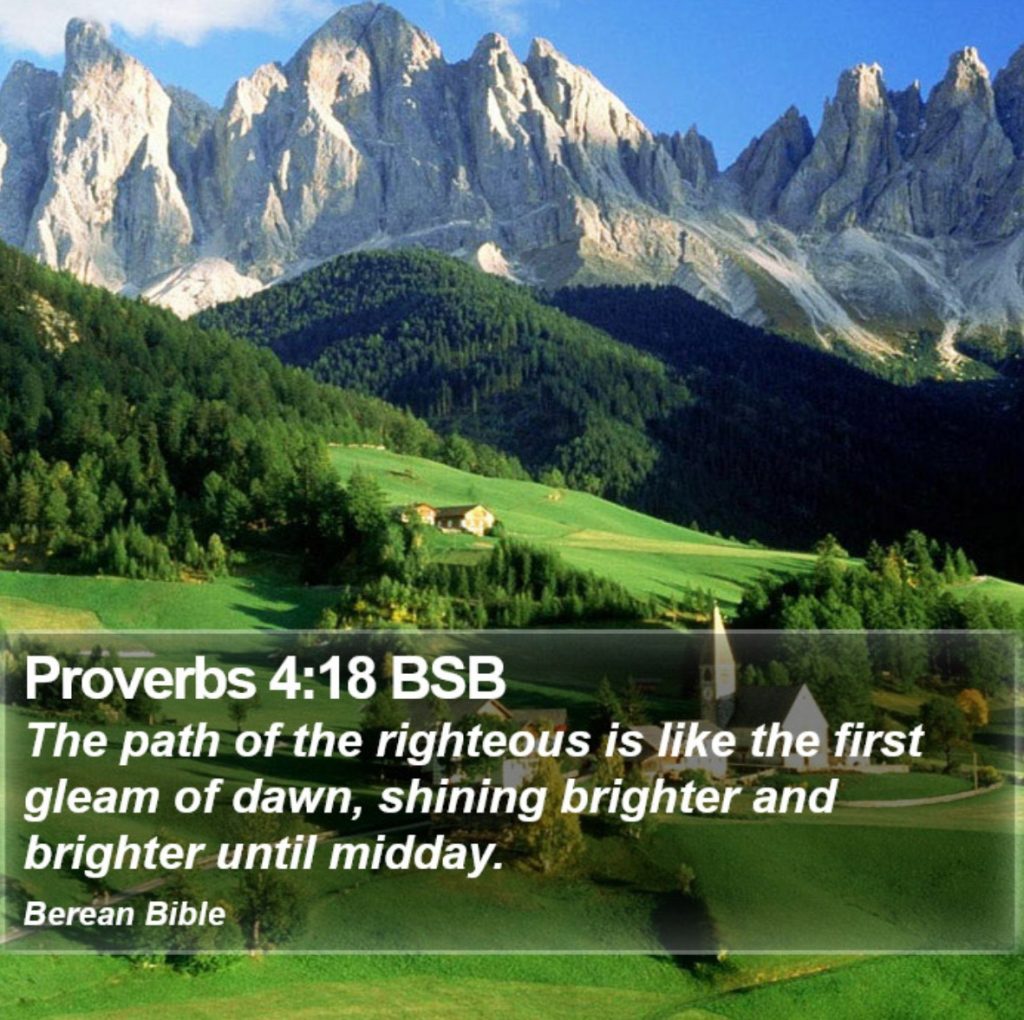
It is a brightly lit path that grows brighter and brighter. “But the path of the just is like the shining sun, that shines ever brighter unto the perfect day” (Proverbs 4:18). It may not seem that way in the beginning, because we don’t yet see all the benefits. This path may even seem a bit restrictive; we may feel it’s “cramping our style.” But the longer we stay on it, the brighter it gets. Just ask any older Christian, who has been on this path for many years.
It is the only path that leads to eternal life, to eternal joy and gladness. “In the way of righteousness is life, and in its pathway there is no death” (Proverbs 12:28). Isaiah describes this path as the “Highway of Holiness” (Isaiah 35:8), and says those who walk on it will “come to Zion with singing, with everlasting joy on their heads. They shall obtain joy and gladness, and sorrow and sighing shall flee away” (Isaiah 35:10).
— Via Prattmont Weekly Bulletin, June 15, 2025
——————–
-3-
M’Cheyne’s Daily Bible Reading Schedule
Robert Murray M’Cheyne lived from 1813 to 1843 and made public his Bible reading schedule in 1842. With it in one year, you will have read not only all the Bible, but also the book of Psalms twice and the New Testament twice. The reading is of 4 chapters daily (with a few exceptions for shorter chapters). And it will also have you reading from both the Old and New Testaments for each day.
A chart for it can be accessed and copied for your own use at the following web address:
https://thomastedwards.com/dailybibleread.txt
I keep a copy of it in the Topic Notes of e-Sword (a free digital Bible).
The schedule is only a text file. Here is a sample of it:
Jan 1: Gen 1; Matt 1; Ezra 1; Acts 1
Jan 2: Gen 2; Matt 2; Ezra 2; Acts 2
Jan 3: Gen 3; Matt 3; Ezra 3; Acts 3
——————–
The Steps That Lead to Eternal Salvation
1) Hear the gospel — for that is how faith comes (Rom. 10:17; John 20:30-31).
2) Believe in the deity of Jesus Christ, the Son of God (John 8:24; John 3:18).
3) Repent of sins. For every accountable person has sinned (Romans 3:23; Romans 3:10), which causes one to be spiritually dead (Ephesians 2:1) and separated from God (Isaiah 59:1-2; Romans 6:23). Therefore, repentance of sin is necessary (Luke 13:5; Acts 17:30). For whether the sin seems great or small, there will still be the same penalty for either (Matt. 12:36-37; 2 Cor. 5:10) — and even for a lie (Rev. 21:8).
4) Confess faith in Christ (Rom. 10:9-10; Acts 8:36-38).
5) Be baptized in water for the remission of sins (Mark 16:16; Acts 2:38; 22:16; 1 Pet. 3:21). This is the final step that puts one into Christ (Gal. 3:26-27). For from that baptism, one is then raised as a new creature (2 Cor. 5:17), having all sins forgiven and beginning a new life as a Christian (Rom. 6:3-4). For the one being baptized does so “through faith in the working of God” (Col. 2:12). In other words, believing that God will keep His word and forgive after one submits to these necessary steps. And now as a Christian, we then need to…
6) Continue in the faith by living for the Lord; for, if not, salvation can be lost (Matt. 24:13; Heb. 10:36-39; Rev. 2:10; 2 Pet. 2:20-22).
——————–
Tebeau Street
CHURCH OF CHRIST
1402 Tebeau Street, Waycross, GA 31501
Sunday: 9 a.m. Bible Classes and 10 a.m. Worship Service
Wednesday (all but the first): 7 p.m. Bible Classes
First Wednesday of the month: 7 p.m. Congregational Song Service (about 45 minutes of singing, followed by a short talk)
evangelist/editor: Tom Edwards (912) 281-9917
Tom@ThomasTEdwards.com
https://thomastedwards.com/go/all.htm (This is a link to the older version of the Gospel Observer website, but with bulletins going back to March 4, 1990.)