“Go therefore and make disciples of all the nations…teaching them to observe all that I commanded you; and lo, I am with you always, even to the end of the age” (Matthew 28:19-20, NASB).
——————–
Contents:
1) What God Wants From Us (Jerid Gunter)
——————–
-1-
What God Wants From Us
Jerid Gunter
To Do Justice
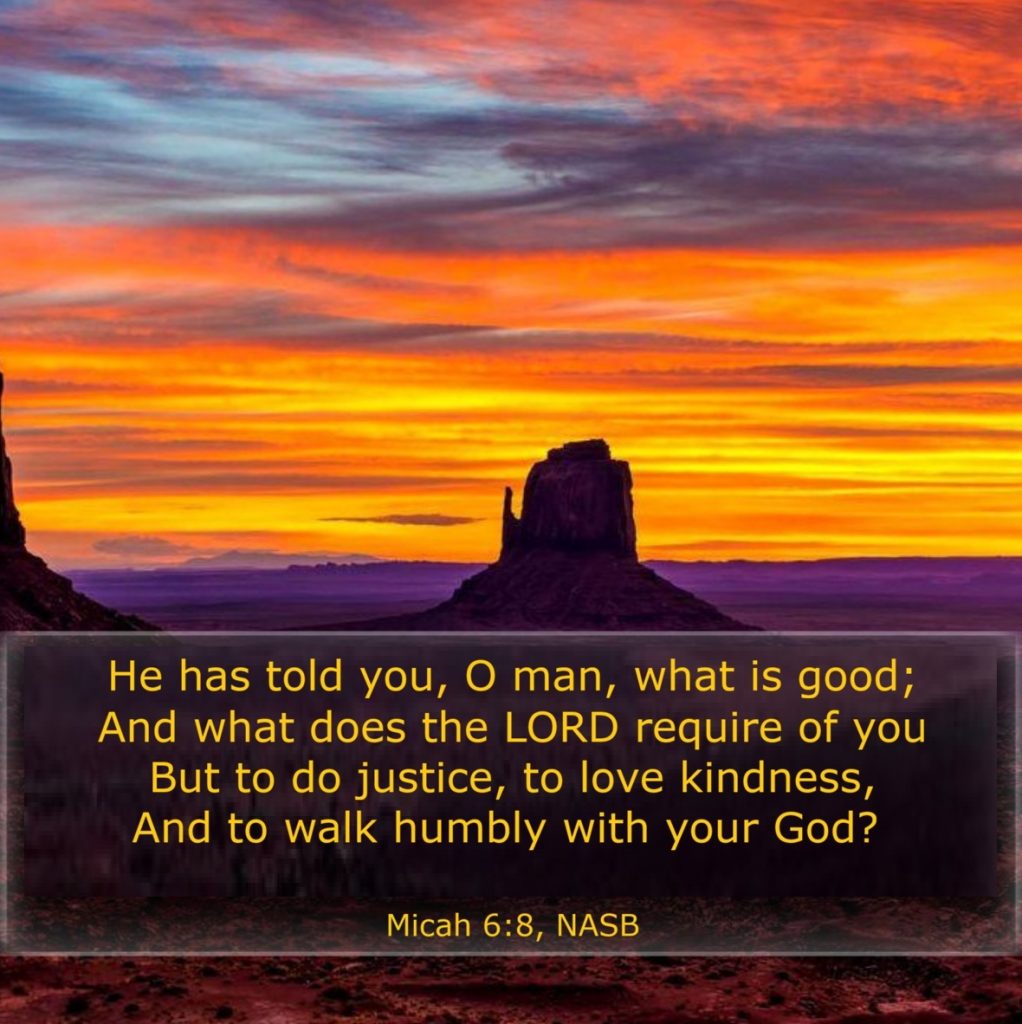
Last week we considered what God would want from us and specifically looked at the words of the prophet Micah in Micah 6:8, “He has told you, O man, what is good; and what does the LORD require of you but to do justice, and to love kindness, and to walk humbly with your God?” To be clear, this is more than a want or a “wish list” from God. These are requirements. While the word “require” may seem overbearing to some, we may need to be reminded of our position in comparison to God. I don’t typically refer to the New International Version Bible, but the word used in place of “man” is “mortal.” If nothing else, remember we’re mortal beings in the presence of the immortal God.
So, what about those requirements? The first one mentioned is “to do justice.” How exactly does one do justice? Does it mean we take the law into our own hands and serve as judge, jury, and executioner for matters pertaining to our life? Not hardly. Remember the context: Micah is focused on the people of Judah and their attitude. Looking earlier in the text (i.e. Micah 2:1, 2, 8), we can see they were unjust and evil. Clearly, God wants the opposite – both then and now! God want’s our mode of operation to be focused on always doing what’s right. Sounds like a no brainer, but let’s think about the challenge of this expectation through the eyes of a challenged biblical character: Joseph
Joseph’s story begins in Genesis 37 and he was the favorite son of Jacob (aka Israel). He had some big, interesting dreams too. Being the favorite and such a dreamer led his brothers to hate him – so much so that they sold him into slavery and portrayed him as dead to their father. Joseph wound up in Egypt and became a servant of Potiphar, “the captain of the guard” under Pharaoh’s reign (Genesis 39:1). Potiphar trusted Joseph so much, he put him in charge of his estate (39:6).
It’s quite a comeback story, and it’d be easy for Joseph to become quite arrogant of his success. He essentially had everything he could desire at his fingertips, including Potiphar’s wife, as she was throwing herself at him. With the house empty (39:11), who would know if Joseph took Mrs. Potiphar’s offer? Instead, Joseph chose “to do justice.” Look at Joseph’s response to Potiphar’s wife in 39:8-9, “But he refused and said to his master’s wife, ‘Behold, because of me my master has no concern about anything in the house, and he has put everything that he has in my charge. He is not greater in this house than I am, nor has he kept back anything from me except you, because you are his wife. How then can I do this great wickedness and sin against God?’” Even after this response, she persisted and he resisted…and then ended up in prison due to her slanderous lies. While he was unjustly treated, he chose to act justly. He stood for what was morally right, regardless of consequence.
If that weren’t enough, Joseph rose to even greater prominence becoming second in command behind Pharaoh. A famine arose and he had a prime opportunity to execute revenge on his unknowing brothers as they came to Egypt desperate for food (Genesis 42-46). Yet again, Joseph chose to look past the heartache and temptation of revenge and he did justice. In other words, he did what God wanted. Let’s be sure to give God what He wants as well.
To Love Kindness
How’s the list coming? No, not your Santa shopping list…the one we’ve been talking about the past couple weeks: God’s expectations from us. Last week we specifically looked at doing “justice” – to do what’s right at all times in all circumstances. So without further delay, let’s look at our key verse again and learn the next expectation:
Micah 6:8, “He has told you, O man, what is good; and what does the LORD require of you but to do justice, and to love kindness, and to walk humbly with your God?”
“To love kindness.” In other Bible translations you may read the phrase “to love mercy” instead. Whether you prefer the word kindness or mercy, it’s safe to say they’re quite relatable to one another and go hand-in-hand with God’s first requirement of always doing what’s right. With loving kindness/mercy, we can see the idea of desiring not only to do what’s right in our own actions, but also extend that righteous attitude in how we respond to others in life.
It’s no secret that we all struggle with doing what’s right all the time, but we have to remember that fact when others don’t do right by us. In fact, in Jesus’ Sermon on the Mount He commanded, “…Love your enemies and pray for those who persecute you, so that you may be sons of your Father who is in heaven. For he makes his sun rise on the evil and on the good, and sends rain on the just and on the unjust” (Matthew 5:44-45). In this passage alone, we see a couple reasons to love kindness. First of all, we see that God Himself is kind and merciful by sending rain on both the just and the unjust – He provides good things for all. Secondly, our task is to love even those who are seemingly unlovable and unjust as it could be what allows or prevents us from being considered children of God.
Undoubtedly, the greatest example of loving kindness/mercy is displayed in Christ going to the cross. There’s no way I could sum it up any better than what Paul wrote in Romans 5:6–8: “For while we were still weak, at the right time Christ died for the ungodly. For one will scarcely die for a righteous person—though perhaps for a good person one would dare even to die—but God shows his love for us in that while we were still sinners, Christ died for us.”
When Jesus spoke about loving your enemies, He was speaking about you and me. He continues to love us, even when we have been the ungodly. While that’s been the case, His love, kindness, and mercy shine through in providing Christ as the ultimate sacrifice. What God wants in return is what He’s already exemplified to perfection.
Walk Humbly With Him
It’s easy to live a life focused on what we want, but to live life in a God-pleasing way, we must consider what God’s desires are first and foremost – and then fulfill them! Over the past few weeks we’ve been focusing on Micah 6:8 and addressing God’s requirements to “do justice” (always doing what’s right), and to “love kindness (or mercy).” The third and final point in Micah’s list is “to walk humbly with your God.”
Where does one even begin with such an amazing thought? The idea of walking with God should be humbling in itself! It’s one thing to be “star-struck” over a celebrity, but there would be nothing more incredible (and humbling) than having the opportunity to walk side-by-side with the Creator of the universe! While we have every desire to be in His presence in eternity, in essence, Micah is telling us we can walk alongside Him now in this life. God will be present in our life if we submit ourselves in obedience to Him!
Perhaps the best way to explain how to “walk humbly with your God” is to look at a man in Scripture who was described as doing so himself. In Genesis 6:9 we read that, “Noah was a righteous man, blameless in his generation. Noah walked with God.” When we see the word “blameless,” we may assume it means “sinless.” Based on what Paul wrote in Romans 3, we know there’s no man (aside from Jesus) who fits that description. Instead, another word that is rendered from the same Hebrew word for “blameless” is “integrity,” and perhaps that’s an easier word to run with here. Noah had integrity – he “did justice” – when the rest of the world did not. So by comparison, Noah was “blameless” and he “walked with God.”
If we’re to believe the apostle Peter (and I do!), it would be safe to say that Noah “loved kindness” as well. Peter referred to Noah as, “a herald of righteousness” in 2 Peter 2:5, and in 1 Peter 3:20 he reported that, “God’s patience waited in the days of Noah, while the ark was being prepared…” When we put those two thoughts together, I believe it’s clear that Noah wasn’t just building a big boat for himself and his family. For Noah to be a “herald,” it means that he was a messenger. Noah was displaying his faith and submission not only in actively building the ark, but verbally warning people of the coming flood due to the world’s sinfulness. That’s integrity (doing justice). That’s being merciful (loving kindness). That’s submission (walking humbly with God).
Finally, we need to point out the personal aspect of this. Micah didn’t just say “walk humbly with God.” That’s amazing enough. What Micah said was to “walk humbly with YOUR God.” While Micah was speaking to Judah at the time, his words still ring true today: God can be YOUR God too. If we truly care for what God requires of His creation – doing justice, loving kindness, and walking humbly with Him, He will recognize us as His because we will be resembling His precious Son (Philippians 2:5-8). May we all give God what He so richly deserves!
— Via Articles from the Beaver Dam church of Christ, originally posted in 3 parts: December 11,18, 22, 2018
——————–
The Steps That Lead to Eternal Salvation
1) Hear the gospel — for that is how faith comes (Rom. 10:17; John 20:30-31).
2) Believe in the deity of Jesus Christ, the Son of God (John 8:24; John 3:18).
3) Repent of sins. For every accountable person has sinned (Romans 3:23; Romans 3:10), which causes one to be spiritually dead (Ephesians 2:1) and separated from God (Isaiah 59:1-2; Romans 6:23). Therefore, repentance of sin is necessary (Luke 13:5; Acts 17:30). For whether the sin seems great or small, there will still be the same penalty for either (Matt. 12:36-37; 2 Cor. 5:10) — and even for a lie (Rev. 21:8).
4) Confess faith in Christ (Rom. 10:9-10; Acts 8:36-38).
5) Be baptized in water for the remission of sins (Mark 16:16; Acts 2:38; 22:16; 1 Pet. 3:21). This is the final step that puts one into Christ (Gal. 3:26-27). For from that baptism, one is then raised as a new creature (2 Cor. 5:17), having all sins forgiven and beginning a new life as a Christian (Rom. 6:3-4). For the one being baptized does so “through faith in the working of God” (Col. 2:12). In other words, believing that God will keep His word and forgive after one submits to these necessary steps. And now as a Christian, we then need to…
6) Continue in the faith by living for the Lord; for, if not, salvation can be lost (Matt. 24:13; Heb. 10:36-39; Rev. 2:10; 2 Pet. 2:20-22).
——————–
Tebeau Street
CHURCH OF CHRIST
1402 Tebeau Street, Waycross, GA 31501
Sunday: 9 a.m. Bible Classes and 10 a.m. Worship Service
Wednesday (all but the first): 7 p.m. Bible Classes
First Wednesday of the month: 7 p.m. Congregational Song Service (about 45 minutes of singing, followed by a short talk)
evangelist/editor: Tom Edwards (912) 281-9917
Tom@ThomasTEdwards.com
https://thomastedwards.com/go/all.htm (This is a link to the older version of the Gospel Observer website, but with bulletins going back to March 4, 1990.)