“Go therefore and make disciples of all the nations…teaching them to observe all that I commanded you; and lo, I am with you always, even to the end of the age” (Matthew 28:19-20, NASB).
——————–
Contents:
1) Building a Good Name (Bryan Gibson)
2) “You Seek Me…Because You Ate of the Loaves and Were Filled” (R.J. Evans)
——————–

-1-
Building a Good Name
Bryan Gibson
Found among the qualifications for elders: “he must have a good testimony among those who are outside, lest he fall into reproach and the snare of the devil” (1 Timothy 3:7). So an elder must have a good reputation, not just among his brothers and sisters in Christ, but also among those outside the church. “A good name in the community” is how we might express it.
But a good name is not just important for elders. “All the people of my town know you are a virtuous woman” (Ruth 3:11)—that’s what Boaz said about Ruth, and it sure would be great if the people of our town thought that highly of each one of us. What else does the Bible say about a good name?
A good name is a very valuable asset.
“A good name is to be chosen rather than great riches…” (Proverbs 22:1). “A good name is better than precious ointment…” (Ecclesiastes 7:1). Why so valuable? Because it greatly affects the influence we have on those around us. It’s awful hard to be the salt of the earth and the light of the world if our reputation has been damaged (see Matthew 5:13-16).
It takes many deeds to build a good name, only one to lose it.
Seems unfair, but experience bears it out. Here’s one way a good reputation can be ruined: “Debate your case with your neighbor, and do not disclose the secret to another; lest he who hears it expose your shame, and your reputation be ruined” (Proverbs 25:9-10). Showing a lack of trustworthiness—telling something we should not—is a good way to ruin a good name. I’m sure you can think of many others. Sometimes, we don’t even have to do anything wrong to lose our good name; it could be we’re just guilty of suspicious behavior. See 2 Corinthians 8:16-21 for how Paul was careful to avoid even the appearance of evil. A Chinese proverb says, “When walking in your neighbor’s melon patch, don’t stop to tie your shoe.” You may not be stealing any melons, but it sure looks like it. How people perceive our actions—that’s important, too.
A good name is important, but character comes FIRST.
The difference between reputation and character? He’s obviously not an inspired writer, but Thomas Paine put it this way: “Reputation is what men and women think of us. Character is what God knows about us.” The first order of business will always be to please God, to develop the kind of character with which He is pleased, and if we can do that, the good reputation will follow. You can see this illustrated in 1 Samuel 2:26 (“Samuel grew…in favor both with the Lord and men”) and Luke 2:52 (“Jesus increased…in favor with God and men”).
It is possible to have a good reputation, to be well spoken of by men, but still not be pleasing to God.
This was certainly the case with the church at Sardis: “you have a name that you are alive, but you are dead” (Revelation 3:1). Another example would be the Pharisees who did enough to gain a good reputation among at least some of their fellow Jews, but were far from pleasing to God (Matthew 23:23, 25, 28). We can sometimes fool people; we can never fool God.
Conclusion
The ultimate aim in all this? To have the same thing said about us that was said about Demetrius. Read it carefully. “Demetrius has a good testimony from all, and from the truth itself. And we also bear witness, and you know that our testimony is true” (3 John 1:12). It’s great when witnesses all around speak well of us; it’s even better when the witness is the truth itself.
— Via the Weekly Bulletin of the Prattmont church of Christ, June 2, 2024
——————–
-2-
“You Seek Me…Because You Ate of the Loaves and Were Filled”
R.J. Evans
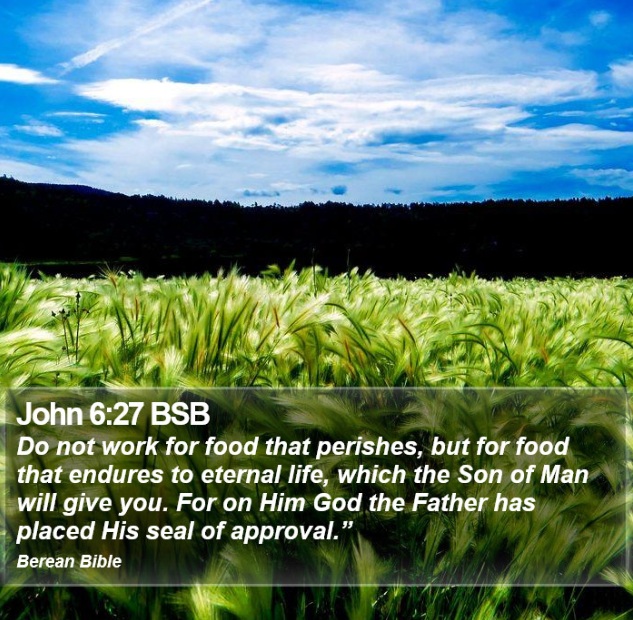
While Jesus was here on earth, He told a large group of people, “Most assuredly, I say to you, you seek Me, not because you saw the signs, but because you ate of the loaves and were filled” (Jn. 6:26). He stated this after He fed the five thousand and had perceived that the multitude wanted to take Him and by force make Him their king (Jn. 6:1-15). That evening His disciples were going across the Sea of Galilee by boat, and Jesus came to them walking on the water (Jn. 6:15-21). The next day, when the crowd realized that Jesus had gone to the other side of the sea, they got in their boats seeking to find Him (Jn. 6:22-25). It was on this occasion, under these circumstances, that Jesus rebuked them for seeking Him for the wrong reason (v. 26). To put it all in perspective, Jesus went on to say, “Do not labor for the food which perishes, but for the food which endures to everlasting life, which the Son of Man will give you, because God the Father has set His seal on Him” (Jn. 6:27).
It is so interesting, as well as disappointing, that brethren today think the same way concerning the church—its worship, work, and mission. Somehow, they have convinced themselves that the church is to be “filled” with worldly things that will attract large crowds of people who will be spiritually minded as they grow and develop. But this is not true! It is most certainly a falsehood and a deception.
Worldly activities never produce anything but that which is also worldly and carnal. Why do some think that bringing in “loaves and fishes” (dining/banquet halls, entertainment, ball teams, etc.) will appeal to spiritually minded people? Or, that these kind of activities will increase one’s spirituality? The more carnal, worldly things that are brought in, the more worldly and fleshly things will be required to keep the kind of people who have been drawn in by all these unscriptural activities. There is an often-used slogan that in effect says: “If we use hamburgers and hot dogs to draw people to the church, then we will have to continue to provide hamburgers, hot dogs, and much more, to keep them.” It is the gospel of Christ that is “the power of God to salvation”–not fun, food, and frolic! (Rom. 1:16; 1 Cor. 1:21; 15:1-2; Jn. 6:44-45)
It is unfortunate to see so many of our brethren caught up in the “social gospel” today. The difference between the individual and home activities, as opposed to the worship, mission and work of the church, is clearly set forth by what the Apostle Paul told the Corinthians. He strongly rebuked them because they had perverted their worship by turning the Lord’s Supper into a feast or meal. “What! Do you not have houses to eat and drink in? Or do you despise the church of God and shame those who have nothing? What shall I say to you? Shall I praise you in this? I do not praise you….But if anyone is hungry, let him eat at home, lest you come together for judgment. And the rest I will set in order when I come” (1 Cor. 11:22, 34). The difference between the role of an individual Christian versus the role of the church is also set forth by Paul in the context about the work of caring for widows in 1 Timothy 5:3-16. The last verse of this paragraph makes the difference clear and distinct: “If any believing man or woman has widows, let them relieve them, and do not let the church be burdened, that it may relieve those who are really widows” (v. 16).
Are you seeking true worshipers who “will worship the Father in spirit and truth” (Jn. 4:23-24)? Or, are you one who seeks to be “filled” with “the loaves” (Jn. 6:26-27)?
— Via a bulletin of the Southside church of Christ, Gonzales, LA, April 28, 2019
——————–
The Steps That Lead to Eternal Salvation
1) Hear the gospel — for that is how faith comes (Rom. 10:17; John 20:30-31).
2) Believe in the deity of Jesus Christ, the Son of God (John 8:24; John 3:18).
3) Repent of sins. For every accountable person has sinned (Romans 3:23; Romans 3:10), which causes one to be spiritually dead (Ephesians 2:1) and separated from God (Isaiah 59:1-2; Romans 6:23). Therefore, repentance of sin is necessary (Luke 13:5; Acts 17:30). For whether the sin seems great or small, there will still be the same penalty for either (Matt. 12:36-37; 2 Cor. 5:10) — and even for a lie (Rev. 21:8).
4) Confess faith in Christ (Rom. 10:9-10; Acts 8:36-38).
5) Be baptized in water for the remission of sins (Mark 16:16; Acts 2:38; 22:16; 1 Pet. 3:21). This is the final step that puts one into Christ (Gal. 3:26-27). For from that baptism, one is then raised as a new creature (2 Cor. 5:17), having all sins forgiven and beginning a new life as a Christian (Rom. 6:3-4). For the one being baptized does so “through faith in the working of God” (Col. 2:12). In other words, believing that God will keep His word and forgive after one submits to these necessary steps. And now as a Christian, we then need to…
6) Continue in the faith by living for the Lord; for, if not, salvation can be lost (Matt. 24:13; Heb. 10:36-39; Rev. 2:10; 2 Pet. 2:20-22).
——————–
Tebeau Street
CHURCH OF CHRIST
1402 Tebeau Street, Waycross, GA 31501
Sunday: 9 a.m. Bible Classes (except for last of the month Song Service)
and 10 a.m. Worship Service
Wednesday: 7 p.m. Bible Classes
evangelist/editor: Tom Edwards (912) 281-9917
Tom@ThomasTEdwards.com
https://thomastedwards.com/go/all.htm (This is a link to the older version of the Gospel Observer website, but with bulletins going back to March 4, 1990.)
Recent Comments