Month: August 2026

The Gospel Observer

“Go therefore and make disciples of all the nations…teaching them to observe all that I commanded you; and lo, I am with you always, even to the end of the age” (Matthew 28:19-20, NASB).
——————–

Contents:

1) “Two Men” (Jarrod M. Jacobs)
2) “Alas, My Brother” (Bobby K. Thompson)

——————–

-1-

“Two Men”

Jarrod M. Jacobs

Two men who stand out in the book of III John are Diotrephes and Demetrius. In context, John told Gaius that he had tried to write to the church, but “Diotrephes, who loveth to have the preeminence among them, receiveth us not” (v. 9). Diotrephes had his self-interest in mind in the congregation. He wanted what belongs to Christ – preeminence (Matt. 28:18; Col. 1:15-18)! In contrast, it seems Demetrius was satisfied with simply serving the Lord according to the Scriptures. These two men stood as polar opposites in this book. As we read III John and make personal applications, consider how these examples challenge us to reflect on our own character and conduct in the church today.

As we read III John 9-12, we see that Diotrephes was overcome with pride (v. 9). He refused John as well as others who were teaching the truth. I.e., those who would challenge his self-imposed authority! In contrast, Demetrius had a “good report” with men and a “good report” of the truth (v. 12)! How can John say this? It speaks to Demetrius’ reputation and character. Demetrius had a reputation and character that pleased God and blessed his fellow man, and Diotrephes did not have this. When we take time to look into God’s spiritual mirror (Jas. 1:25; II Cor. 13:5), what do we see reflected – are we more like Demetrius or Diotrephes? May this reflection motivate us to pursue spiritual growth and repentance.

There is also a significant contrast between these men’s words and deeds! No doubt, both would claim to love God. Yet, Diotrephes’ deeds were evidence of the opposite of love! Look at what he did. He would not receive the sound brethren, he stood opposed to those who would receive them, and spoke malicious words about them (III Jn. 10). In response, John said: “I will remember his deeds” (III Jn. 10)! Conversely, Demetrius had a “good report” (III Jn. 12). Obviously, he was doing what he was supposed to!

Based on these facts, don’t you imagine these men were faithful to attend when the church assembled? Probably so! I would conjecture that these men might have preached some, or taught a Bible class. Maybe they led songs or a prayer, or served at the Lord’s Table. The question is why were they assembled? Based on what John said to Gaius, I believe one attended to keep his power structure intact. The other was assembling with the saints to worship God in spirit and in truth (Jn. 4:24). Friend, why do you attend the worship services of the saints (Heb. 10:25)?

When we read about Diotrephes, it is evident that he is a manipulator. He didn’t receive the apostles or others who were teaching the truth (v. 9). He used malicious words against these men and others (v. 10). At the same time, there must have been folks who believed and followed him, or he wouldn’t be able to continue in his actions. In contrast, Demetrius was an edifier (“good report of all men”). He followed the words of the apostle Paul (Eph. 4:29). Like Demetrius, let us control our tongues and not speak malicious words concerning others. Let us speak godly words that will be useful in edifying folks. Let us not lie to one another, but speak the truth to each other (Eph. 4:25, 29). Let us speak words in kindness and love for each other, and especially have our speech “alway with grace, seasoned with salt” to know how to answer every man, and win them to the Lord (Col. 4:6).

However, let us not get the idea that, since Diotrephes and Demetrius were contrasted, this means that a local church can harbor such arrogance and error as Diotrephes possessed without confrontation, or expectation of repentance. Remember John said, “if I come…” what will happen (v. 10). If he had the chance to visit, he would “bring to remembrance his deeds …” (v. 10). John also told Gaius not to follow or imitate what is evil, but follow what is good (vv. 10-11). Does this sound like one who was coming to say, “I’m ok, and you’re ok, let’s try to get along”? “Preeminent” or not, powerful or not, one who is in sin needs to be challenged and convicted of his sin that he might repent and “bring forth fruit unto God” (Rom. 7:4). At the same time, men like Gaius and Demetrius would be encouraged and strengthened (vv. 13-14). John was coming to speak to him face to face. Manipulators have no place in the Lord’s church.

Dear friends, when we look into God’s mirror, what do we see? Which one are we? Now is the time to examine ourselves and repent before it is too late!

— via The Ancient Landmark, 8/13/2026

——————–

-2-

“Alas, My Brother”

Bobby K. Thompson

1 Kings 13 presents a very melancholy story. It is always infinitely sad to see those who were once faithful in the service of God fall. It is pathetic to behold those who were once “meet for the master’s use” tripped up in the end through temptation, and become prey to him who walks about like a roaring lion seeking whom he may devour. This chapter of 1 Kings deals with the exploits of a servant of God who began well, preached faithfully for a period, but had a tragic end. We say it happened to others but it can never be my lot. Alas, my brother! You had best take heed. “Let him that thinketh he standeth take heed lest he fall” (1 Cor. 10:12). There are seven things about this unfortunate man that we desire to point out:

1. He was a true believer. He is called “A man of God” (v. 1). He was not a mere “man of the world” whose portion is in this life, but one who has personal dealings with God, and who, in heart and life, belonged to him. He was not a mere professor or time-server, but a true servant of God.

2. He was a man with a message. He came “by the word of the Lord unto Bethel” (v. 1). He had a ministry committed to him by God, a message of warning and condemnation. No evangelist was ever more surely called of God than this man. The narration abounds with evidence that he was sent by God.

3. He was a man of courage. “And he cried against the altar in the Word of the Lord” (v. 2). He testified with a loud voice against this altar built by Jeroboam as a rival of Jehovah’s, even while the king “stood by.” The Word of God evidently burned in his bones and he could not but speak the things which he had heard from him. It was similar with Peter and John in Acts 4:20.

4. He was a man with power. God bore witness to his testimony by signs and wonders in the stiffening of the king’s arm and hand which was stretched out to “lay hold on him” and also in the “rending of the altar” and the spilling of ashes. The servant of God had every reason to believe that God was with him and what he was doing was God approved. He knew such power was not from himself.

5. He was a man of self-denial. After prayer for the restoration of the king’s hand, the king asked him, “Come home with me, and refresh thyself, and I will give thee a reward,” but he would not (vv. 6-9). The Lord had charged him not to do so! He was no hireling in the work of the Lord. He knew what it was to deny himself and be true to God’s directions in saying “No” to the king. Surely such a mighty man as this will never fall! But, alas!

6. He believed a lie and fell through deception. The old prophet pretended that an angel had spoken to him, saying, “Bring him back with thee into thine house, that he may eat bread and drink water. But he lied unto him” (v. 18). He turned aside from the revealed will of God to obey the invention of man. “So he went back with him, and did eat bread in his house, and drank water.” The temptation was doubtlessly great, but his was perfectly clear. He knew God’s will. In obeying the false prophet he was contradicting the will of God that he had previously been so faithful in its execution. “Beloved, believe not every spirit, but try the spirits whether they are of God: because many false prophets are gone out into the world” (1 Jn. 4:1). He didn’t try the old prophet as he should have or else he just threw all conviction or proper reason to the wind and gave in to the stronger call to eat and drink with him. Regardless of the explanation, this man disobeyed God and it cost him his life. No more was he to carry the message of God. He had forfeited his life by believing and obeying a lie. Truly pathetic, but true!

7. He was mourned over by the one who deceived him. “He laid his carcass in his own grave; and they mourned over him, saying, Alas, my brother!” (v. 30). Yes, well may he mourn, after tempting the man of God into the net of destruction. Even being buried in the same grave will not atone for the sin of deception. How will he face him in the judgment whom he had lured from the will of God by substituting his own thoughts for God’s? How shall it fare with the false teachers of our day when in the presence of God they are face to face with the fact that they have led souls to disobey?

“Alas, my brother,” take heed who you hear and what you hear! It can happen to us. These things were written for our learning…

— via Articles from the Knollwood church Christ, August 2026

______________

The Steps That Lead to Eternal Salvation

1) Hear the gospel — for that is how faith comes (Rom. 10:17; John 20:30-31).
   
2) Believe 
in the deity of Jesus Christ, the Son of God (John 8:24; John 3:18).

3) Repent 
of sins.  For every accountable person has sinned (Romans 3:23; Romans 3:10), which causes one to be spiritually dead (Ephesians 2:1) and separated from God (Isaiah 59:1-2; Romans 6:23). Therefore, repentance of sin is necessary (Luke 13:5; Acts 17:30).  For whether the sin seems great or small, there will still be the same penalty for either (Matt. 12:36-37; 2 Cor. 5:10) — and even for a lie (Rev. 21:8).

4) Confess faith 
in Christ (Rom. 10:9-10; Acts 8:36-38).

5) Be baptized 
in water for the remission of sins (Mark 16:16; Acts 2:38; 22:16; 1 Pet. 3:21).  This is the final step that puts one into Christ (Gal. 3:26-27).  For from that baptism, one is then raised as a new creature (2 Cor. 5:17), having all sins forgiven and beginning a new life as a Christian (Rom. 6:3-4). For the one being baptized does so “through faith in the working of God” (Col. 2:12). In other words, believing that God will keep His word and forgive after one submits to these necessary steps. And now as a Christian, we then need to…

6) Continue in the faith
by living for the Lord; for, if not, salvation can be lost (Matt. 24:13; Heb. 10:36-39; Rev. 2:10; 2 Pet. 2:20-22).
——————–

Tebeau Street
CHURCH OF CHRIST
1402 Tebeau Street, Waycross, GA  31501

Sunday: 9 a.m. Bible Classes (except for last of the month Song Service)
and 10 a.m. Worship Service
Wednesday: 7 p.m. Bible Classes 
 
evangelist/editor: Tom Edwards (912) 281-9917
Tom@ThomasTEdwards.com

https://thomastedwards.com/go/all.htm (This is a link to the older version of the Gospel Observer website, but with bulletins going back to March 4, 1990.)


The Gospel Observer

“Go therefore and make disciples of all the nations…teaching them to observe all that I commanded you; and lo, I am with you always, even to the end of the age” (Matthew 28:19-20, NASB).
——————–

Contents:

1) Responding to Our Enemies (R.J. Evans)
2) Better Things (Bryan Gibson)
3) Psalm 119:65-72 (Berean Study Bible)

——————–

-1-

Responding to Our Enemies

R.J. Evans

“Blessed are you when they revile and persecute you, and say all kinds of evil against you falsely for my sake” (Matt. 5:11).

How do we handle a person who reviles us, persecutes us, and says things about us which are not true? The natural response is to retaliate and get even. But how are we to respond to our enemies and be pleasing unto God? Let us go to His Word for the answers.

1. Rejoice if we are being mistreated because we are faithfully serving the Lord. If we are suffering because of our evil deeds, then we should be ashamed. However, the Apostle Peter tells us— “Yet if anyone suffers as a Christian, let him not be ashamed, but let him glorify God in this matter” (1 Pet. 3:15-16). Notice the next verse following our text: “Rejoice and be exceeding glad, for great is your reward in heaven, for so they persecuted the prophets who were before you” (Matt. 5:12). Although some may seek to make our lives miserable here on earth, our reward in heaven will be great if we remain faithful while we are hurting for His sake.

2. Love them, do good to them, and pray for them. This is what Jesus was teaching in Matthew 5:44: “But I say to you, love your enemies, bless those who curse you, do good to those who hate you, and pray for those who spitefully use you and persecute you.” Normally, we will have to do a lot of praying for ourselves, asking for strength, before we will be able to do this for our enemies. But we will reap many benefits if we can sincerely do what Jesus commands in this passage. Again, let us observe the inspired words of the Apostle Peter, as it relates to this kind of situation. “…not returning evil for evil or reviling for reviling, but on the contrary blessing, knowing that you were called to this, that you may inherit a blessing” (1 Pet. 3:9). Remember—this is the example Jesus left for us and we are to follow in His steps. “For to this you were called, because Christ also suffered for us, leaving us an example, that you should follow His steps: ‘Who committed no sin, nor was guile found in His mouth,’ who, when He was reviled, did not revile in return; when He suffered, He did not threaten, but committed Himself to Him who judges righteously” (1 Pet. 2:21-23).

3. Turn it over to God. When men crucified our Lord, He prayed, “Father, forgive them, for they do not know what they do” (Lk. 23:34). In one short prayer, we find Jesus loving His enemies, blessing His enemies, and praying for His enemies. The Apostle Paul tells us to turn it over to God when he said: “Beloved, do not avenge yourselves, but rather give place to wrath; for it is written, ‘Vengeance is Mine, I will repay,’ says the Lord. Therefore if your enemy hungers, feed him; if he thirsts, give him a drink; For in so doing you will heap coals of fire on his head: Do not be overcome by evil, but overcome evil with good” (Rom. 12:19-21). This is basically what Christ was teaching in His “Sermon on the Mount” in Matthew 5:38-48.

In a sense, we are being good to ourselves when we are good to our enemies.  May the Lord help and be with us when we are meeting the challenge of correctly responding to our enemies.

— Via The Auburn Beacon

——————–

-2-

Better Things

Bryan Gibson

We like to compare things—this team is better than that team; this restaurant is better than that one, etc. In some cases, we’re just expressing an opinion or a personal taste; we really don’t have enough information to be certain. But if God says one thing is better than another, there’s no room for argument. God does make statements like these, primarily in the books of Psalms, Proverbs, and Ecclesiastes. These are extremely profitable to us, because they help us set our priorities; they help us to see what is truly important. Let’s take a look at some of them.

Many things are better than riches—the law of God (Psalms 119:72); knowledge, wisdom, and understanding (Proverbs 3:13-14; 8:10-11, 19; 16:16); a good name (Proverbs 22:1; Ecclesiastes 7:1); and virtues such as righteousness, godliness, faith, love, patience, and gentleness (1 Timothy 6:10-11). Moses certainly understood this, because he chose the riches of God over the riches of Egypt (Hebrews 11:24-26).

The poor man, who has the above things, is better off than the rich man who does not (Psalms 37:16; Proverbs 15:16-17; 16:8, 19; 17:1; 28:6; Eccl. 4:6). Don’t envy the rich man too much, especially if he’s had to sacrifice these better things to acquire lesser things.

What you have now (materially speaking) is better than what you hope to have one day (Ecclesiastes 6:9). Sometimes we can’t enjoy what we have now for thinking about what we would like to have. Why keep postponing happiness?

It is better to trust in God than to trust in man (Psalms 118:8-9; 146:3-7). Lots of
folks discover this the hard way, after they’ve been led astray. Sadly, others won’t learn this lesson until it’s too late.

It is better not to make a promise, than to make a promise and not keep it (Ecclesiastes 5:2-5). Too many broken promises and there goes our good name. God is clear: don’t make promises you can’t keep.

A love that rebukes is better than a love that ignores faults (Proverbs 27:5; Ecclesiastes 7:5). Friends who love us enough to correct us—that’s what we need. Jesus said, “As many as I love, I rebuke and chasten” (Revelation 3:19).

Ruling your spirit is better than ruling a city (Proverbs 16:32). We tend to glorify the physically strong; God does just the opposite. It takes more strength to conquer oneself than to conquer others (it actually takes HIS strength to conquer self).

It is better to go to the house of mourning (a funeral) than the house of feasting (a party), for it is in the house of mourning that we learn the most valuable lessons (Ecclesiastes 7:2-4). It’s hard to go there and not think about the brevity and uncertainty of life.

The end of a thing is better than its beginning—so be patient (Ecclesiastes 7:8). This certainly applies to childrearing. Sometimes we give up too too soon, when we don’t see any immediate effects of our teaching and discipline. Hebrews 12:11 should help us here: “Now no chastening seems to be joyful for the present, but painful; nevertheless, afterward it yields the peaceable fruit of righteousness to those who have been trained by it.” And of course it also applies to prayer—sometimes we have to “wait on the Lord” (Isaiah 40:27-31).

Two are better than one, so value your friends, your marriage companion, your family, your fellow-Christians (Ecclesiastes 4:7-12; Song of Solomon 8:7; Proverbs 17:17; 27:9; 31:10-12). Imagine life without the love and support of others. Not a pretty picture, is it?

— Via the Weekly Bulletin of the Prattville church of Christ, November 26, 2023

——————–

-3-

Psalm 119:65-72

Teth

65You are good to Your servant, O LORD, according to Your word.

66Teach me good judgment and knowledge, for I believe in Your commandments.

67Before I was afflicted, I went astray; but now I keep Your word.

68You are good, and You do what is good; teach me Your statutes.

69Though the arrogant have smeared me with lies, I keep Your precepts with all my heart.

70Their hearts are hard and callous, but I delight in Your law.

71It was good for me to be afflicted, that I might learn Your statutes.

72The law from Your mouth is more precious to me than thousands of pieces of gold and silver.

— Berean Study Bible

______________

The Steps That Lead to Eternal Salvation

1) Hear the gospel — for that is how faith comes (Rom. 10:17; John 20:30-31).
   
2) Believe 
in the deity of Jesus Christ, the Son of God (John 8:24; John 3:18).

3) Repent 
of sins.  For every accountable person has sinned (Romans 3:23; Romans 3:10), which causes one to be spiritually dead (Ephesians 2:1) and separated from God (Isaiah 59:1-2; Romans 6:23). Therefore, repentance of sin is necessary (Luke 13:5; Acts 17:30).  For whether the sin seems great or small, there will still be the same penalty for either (Matt. 12:36-37; 2 Cor. 5:10) — and even for a lie (Rev. 21:8).

4) Confess faith 
in Christ (Rom. 10:9-10; Acts 8:36-38).

5) Be baptized
 in water for the remission of sins (Mark 16:16; Acts 2:38; 22:16; 1 Pet. 3:21).  This is the final step that puts one into Christ (Gal. 3:26-27).  For from that baptism, one is then raised as a new creature (2 Cor. 5:17), having all sins forgiven and beginning a new life as a Christian (Rom. 6:3-4). For the one being baptized does so “through faith in the working of God” (Col. 2:12). In other words, believing that God will keep His word and forgive after one submits to these necessary steps. And now as a Christian, we then need to…

6) Continue in the faith
by living for the Lord; for, if not, salvation can be lost (Matt. 24:13; Heb. 10:36-39; Rev. 2:10; 2 Pet. 2:20-22).
——————–

Tebeau Street
CHURCH OF CHRIST
1402 Tebeau Street, Waycross, GA  31501

Sunday: 9 a.m. Bible Classes (except for last of the month Song Service)
and 10 a.m. Worship Service
Wednesday: 7 p.m. Bible Classes 
 
evangelist/editor: Tom Edwards (912) 281-9917
Tom@ThomasTEdwards.com

https://thomastedwards.com/go/all.htm (This is a link to the older version of the Gospel Observer website, but with bulletins going back to March 4, 1990.)

The Gospel Observer

“Go therefore and make disciples of all the nations…teaching them to observe all that I commanded you; and lo, I am with you always, even to the end of the age” (Matthew 28:19-20, NASB).
——————–

Contents:

1) Forgetting and Remembering (Mark Mayberry)

——————–

-1-

Forgetting and Remembering

Mark Mayberry

The Bible repeatedly emphasizes the importance of remembering and the danger of forgetting. Let us heed these admonitions and make appropriate application to our lives.

Introduction

When an elderly husband and wife began forgetting little things, they visited their doctor, who suggested, “Many people find it useful to write brief notes to themselves.” The wife thought it was a good idea, but the husband (as husbands often do) balked. “I don’t need no stupid notepad! My memory is fine!”

After returning home, the wife said, “Honey, will you please go to the kitchen and get me a dish of Blue-Bell ice cream? Maybe you should write it down so you won’t forget?”

“That’s silly!” He exclaimed. “I can remember a dish of ice cream.”

“O.K.” says the missus, “Please put some strawberries and whipped cream on the top. Also, please bring a cookie. Now, can you remember all that?”

“Women!” He muttered. “A dish of ice cream with strawberries and whipped cream. And a cookie. I. Can. Remember. I don’t need to write it down.”

The husband goes into the kitchen; his wife hears pots and pans banging around. Finally, he emerges from the kitchen and presents her with a plate of bacon and eggs.

She looks at the plate and asks, “Hey, where’s the toast I asked for?”

The Danger of Forgetting

The Merriam-Webster’s Collegiate Dictionary says the verb “forget” means “(1) to lose the remembrance of: be unable to think of or recall (something); (2) to treat (a matter) with inattention or disregard.”

The International Standard Bible Encyclopedia contains an extensive discussion of forgetfulness. While it may simply denote the loss of memory (Gen. 40:23), it also carries the connotation of being heedless, ignoring something important, etc. It can communicate the concept of losing consciousness of something significant, such as forgetting God, His mighty deeds, His name, or the covenant with Him. “Forget” approaches the meaning “to unlearn” in such passages as Hosea 4:6, where the Lord accuses his people of having forgotten the law (parallel to “rejected knowledge”), etc. It may also connote “overlook, neglect, care little for” (Burke, 340-339).

General Admonitions

Before crossing over the Jordan to inherit the promised land, Moses warned Israel of the danger of forgetting God: “Beware that you do not forget the Lord your God by not keeping His commandments and His ordinances and His statutes which I am commanding you today. . .” (Deut. 8:11-20). Consider the folly of forgetting God: “The wicked will return to Sheol, even all the nations who forget God” (Pss. 9:17; cf. 50:22-23).

Specific Admonitions

Do not forget His benefits/blessings: “Bless the LORD, O my soul, and forget none of His benefits” (Ps. 103:2). Do not forget His covenant: “So watch yourselves, that you do not forget the covenant of the LORD your God which He made with you…” (Deut. 4:23-24). Do not forget His deliverance: “Watch yourself, that you do not forget the LORD who brought you from the land of Egypt, out of the house of slavery” (Deut. 6:12). Do not forget His words/ laws: “I shall delight in Your statutes; I shall not forget Your word” (Ps. 119:16). Do not forget His works/deeds: “They should put their confidence in God and not forget the works of God, but keep His commandments” (Ps. 78:7).

The Need for Remembrance

Sacred Scripture is replete with admonitions to “Remember!” The Greek word mimnēskō, translated “recall, remember” means “(1) to recall information from memory; (2) to think of and call attention to something or someone; (3) give careful consideration to” (BDAG, 652). The Lexham Theological Wordbook says it “refers to the action of bringing to mind past events, people, or words and applying that knowledge to the present.”

The verb “remember” occurs 168 times in the NASB, while “remembrance” is found another 16 times. Moses ordered Israel, “Remember the sabbath day, to keep it holy” (Exod. 20:8). Solomon said, “Remember also your Creator in the days of your youth. . .” (Eccl. 12:1). Jesus exhorted disciples, “Remember Lot’s wife” (Luke 17:32). Correcting the corruptions that had crept into their worship, Paul commanded the Corinthians:

For I received from the Lord that which I also delivered to you, that the Lord Jesus in the night in which He was betrayed took bread; and when He had given thanks, He broke it and said, “This is My body, which is for you; do this in remembrance of Me.” In the same way, He took the cup also after supper, saying, “This cup is the new covenant in My blood; do this, as often as you drink it, in remembrance of Me.” For as often as you eat this bread and drink the cup, you proclaim the Lord’s death until He comes (1 Cor. 11:23-26).

Biblical Examples

While the disciples did not understand the nature of Jesus’s ministry, after the resurrection they remembered his teaching and made accurate application. Namely, the resurrection of Jesus manifested His authority (John 2:18-22, esp. v. 22). The Jews mistakenly thought that the Messianic kingdom would be physical; yet, Jesus’s triumphant entry into Jerusalem manifested, not only His humility but also the distinctive spiritual nature of His reign (John 12:12-16, esp. v. 16).

Simon Peter serves as both a positive and a negative role model. After Judas betrayed Jesus, Peter found himself surrounded by enemies and facing mortal danger. When cowardice replaced supreme self-confidence, Simon thrice denied the Lord—remembering Jesus’s earlier warnings. . . but too late (Luke 22:31-34, 54-62; cf. Matt. 26:75; Mark 14:72; cf. Ps. 137:1-6).

After being baptized in the Holy Spirit on the day of Pentecost, Peter and the other apostles were granted much clearer understanding of God’s redemptive plan (Luke 24:45-49; Acts 1:4-8). Yet, even then, Simon needed an additional vision and demonstration of God’s purpose to understand the universality of the gospel message. After experiencing the vision at Joppa, and seeing the Spirit being poured out on the household of Cornelius, Peter remembered prior teaching of Jesus that applied to the current circumstances (Acts 11:1-18, esp. v. 16).

Biblical Admonitions

Paul’s commendable example among the Ephesians served as a reminder of Jesus’s example and exhortation: “In everything I showed you that by working hard in this manner you must help the weak and remember the words of the Lord Jesus, that He Himself said, ‘It is more blessed to give than to receive’” (Acts 20:25-38, esp. v. 35).

The aged apostle also exhorted Timothy to remember foundational facts about our Lord Jesus Christ (2 Tim. 2:8-13, esp. v. 8). “Remember Jesus Christ. . .” compresses the gospel into three words! In like manner, the parallel epistles of Jude and 2 Peter exhort readers to remember the words spoken beforehand by the holy prophets and inspired apostles of the Lord (2 Pet. 3:1-2; Jude 17-21, esp. v. 17).

Conclusion

The danger of forgetting is real. The prophet Hosea declared, “My people are destroyed for lack of knowledge. Because you have rejected knowledge, I also will reject you from being My priest. Since you have forgotten the law of your God, I also will forget your children (Hos. 4:6). Forgetting was distinct danger to ancient Israel, and remains a present peril to contemporary disciples. God will not forget us, but will we forget Him (Heb. 6:9-12)? Don’t forget to study your Bible daily! Don’t forget to pray! Don’t forget to serve others! Don’t forget to assemble! Don’t forget to worship!

The need for remembrance is great! The theme section of this issue of Truth Magazine focuses upon “Remembering Jesus.” Remembering Jesus, in His various roles and responsibilities, His past, present, and future glory helps us endure hardship and remain faithful. Accordingly, we offer the following articles for your consideration: (1) HIS PREEXISTENCE AND INCARNATION, by Tim Reeves; (2) HIS MINISTRY, by Mark Reeves; (3) HIS DEATH AND RESURRECTION, by Luke Reeves; (4) HIS EXALTATION, by Chris Reeves; (5) HIS AUTHORITY, by Jacob Reeves; (6) HIS RETURN, by Steve Reeves.

Sources

Arndt, William, et al. A Greek-English Lexicon of the New Testament and Other Early Christian Literature (BDAG). Chicago: University of Chicago Press, 2000.

Burke, D. G. “Forget,” The International Standard Bible Encyclopedia, Revised. ed. Geoffrey W. Bromiley. William B. Eerdmans, 1979-1988.

Merriam-Webster’s Collegiate Dictionary. Springfield, MA: Merriam-Webster, 1996.

— Via Truth Magazine, Volume 66, No. 2, February 2022

https://truthmagazine.com/kindle/2022/2022-02-feb/2022-02-Feb-Truth-Magazine.pdf

______________

The Steps That Lead to Eternal Salvation

1) Hear the gospel — for that is how faith comes (Rom. 10:17; John 20:30-31).
   
2) Believe 
in the deity of Jesus Christ, the Son of God (John 8:24; John 3:18).

3) Repent 
of sins.  For every accountable person has sinned (Romans 3:23; Romans 3:10), which causes one to be spiritually dead (Ephesians 2:1) and separated from God (Isaiah 59:1-2; Romans 6:23). Therefore, repentance of sin is necessary (Luke 13:5; Acts 17:30).  For whether the sin seems great or small, there will still be the same penalty for either (Matt. 12:36-37; 2 Cor. 5:10) — and even for a lie (Rev. 21:8).

4) Confess faith 
in Christ (Rom. 10:9-10; Acts 8:36-38).

5) Be baptized 
in water for the remission of sins (Mark 16:16; Acts 2:38; 22:16; 1 Pet. 3:21).  This is the final step that puts one into Christ (Gal. 3:26-27).  For from that baptism, one is then raised as a new creature (2 Cor. 5:17), having all sins forgiven and beginning a new life as a Christian (Rom. 6:3-4). For the one being baptized does so “through faith in the working of God” (Col. 2:12). In other words, believing that God will keep His word and forgive after one submits to these necessary steps. And now as a Christian, we then need to…

6) Continue in the faith
by living for the Lord; for, if not, salvation can be lost (Matt. 24:13; Heb. 10:36-39; Rev. 2:10; 2 Pet. 2:20-22).
——————–

Tebeau Street
CHURCH OF CHRIST
1402 Tebeau Street, Waycross, GA  31501

Sunday: 9 a.m. Bible Classes (except for last of the month Song Service)
and 10 a.m. Worship Service
Wednesday: 7 p.m. Bible Classes 
 
evangelist/editor: Tom Edwards (912) 281-9917
Tom@ThomasTEdwards.com

https://thomastedwards.com/go/all.htm (This is a link to the older version of the Gospel Observer website, but with bulletins going back to March 4, 1990.)

The Gospel Observer

“Go therefore and make disciples of all the nations…teaching them to observe all that I commanded you; and lo, I am with you always, even to the end of the age” (Matthew 28:19-20, NASB).
——————–

Contents:

1) How God Viewed Saul’s Worship (Kyle Pope)
2) Psalm 119:57-64 (Berean Study Bible)
3) Ephesians 2:10 (Berean Study Bible)

——————–

-1-

How God Viewed Saul’s Worship

Kyle Pope

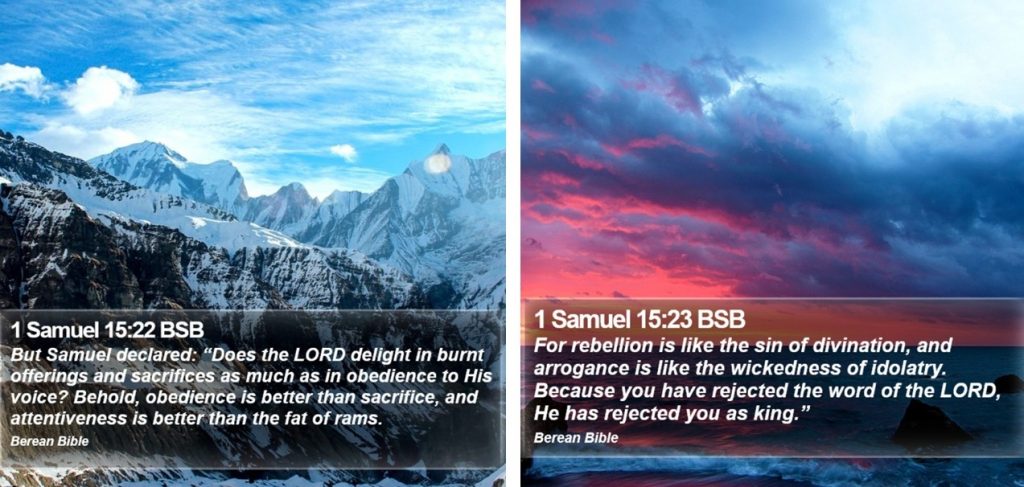
When Samuel rebuked Saul for failing to utterly destroy the Amalekites, whom God had condemned because of their sins against the Israelites in the wilderness (Deut. 25:17-19), Saul tried to defend his actions by claiming the people spared the livestock to sacrifice to God (1 Sam. 15:21). He made the common assumption that anything done with a religious motive is acceptable to God regardless of whether or not God has authorized it. In response, Samuel told him, “to obey is better than sacrifice” (1 Sam. 15:22) going on to explain, “For rebellion is as the sin of witchcraft, and stubbornness is as iniquity and idolatry” (1 Sam. 15:23a, NKJV). This explanation of the importance of obedience warrants our consideration.

The Holy Spirit led Samuel to use two words describing Saul’s actions, both of which were said to be like “witchcraft” or “iniquity and idolatry.” How shocking it must have been to Saul— just as it is often shocking to people today—to hear that something intended as an act of worship was actually like an occult, pagan, and idolatrous act!

We can learn more about this by considering the words Samuel used to describe what Saul had actually done. The first word is consistently translated “rebellion” in almost all English translations. God commanded Saul to “utterly destroy,” not only the people, but “all that they have,” even specifying, “do not spare them” (1 Sam. 15:3). By sparing the king and the best of the livestock Saul had rebelled against God’s command. The Bible in Basic English puts it that Saul had gone “against his orders.” To disobey God’s orders to do an act of worship He had not commanded was just as much a violation of God’s will as if he had practiced “witchcraft” or “divination” (NASB)—a sin he would later actually commit (1 Sam. 28:7-15).

The second word used to describe his actions has proven harder for translators to find a consistent English word that brings out its significance. Early English translations chose the word “stubbornness” (Matthew Bible – 1537; Great Bible – 1539; Bishops Bible – 1568)—a word that has continued to be used in most English translations that have followed it (KJV, ASV, RSV, YLT, NKJV, NLT, NRSV), including some Jewish translations (OJB, JPS). Saul’s actions certainly reflected an attitude of stubbornness. He wanted to do what he wanted to do! Whenever we choose our own desires over anyone or anything else in our relationships with God or others, it reflects an idolatrous way of thinking. Paul warned of those “whose god is their belly” (Phil. 3:19). While Christians should refuse to compromise truth, when it comes to following God’s word (even if it differs from what we want) or when it comes to giving in to others (for their good and to encourage peace and edification), children of God must practice what James describes as the heavenly wisdom that is “willing to yield” (James 3:19).

The word translated “stubbornness” has an unusual literal meaning. The Hebrew word patsar literally means “to press, push” (BDB). It is used only seven times in the Old Testament, and most often in its literal sense (Gen. 19:3, 9; 33:11; Judg. 19:7; 1 Sam. 15:23; 2 Kings 2:17; 5:16). In many of these examples it is used of emotional pressure one uses to urge someone to do something— much the way today we might say someone is “pushy.” What does the use of this term further indicate about Saul’s behavior?

The pushy person is one who always seems to work things out to get his or her way. It doesn’t matter who gets hurt. It doesn’t matter how our actions make others feel. It is “self-will” (Dby). It is “arrogance” (NIV). It is “pride” (BBE). Paul commanded that a Christian should “esteem others better than himself” (Phil. 2:3)—not in the sense of having poor self-esteem, but in a willingness to “look out not only for his own interests, but also for the interests of others” (Phil. 2:4). Saul was the king. He should have been a spiritual leader, urging the people to fully and completely follow the will of God. He didn’t do that. Even when he was rebuked for his sin, his pushy attitude shone through in grabbing the edge of Samuel’s robe and tearing it as Samuel turned to leave (1 Sam. 15:27). He was more concerned about being shamed before the people than the fact that he had displeased God (1 Sam. 15:30-31).

Instead of “stubbornness” a few translators have sought to convey this sense of pressing against God’s will in the choices they have made to translate patsar. Keil and Delitzsch in their Commentary on the Old Testament argue that “rebellion” and patsar are “synonymous in their meaning” (2.157). They use the word “opposition” for patsar. Hebrew Old Testament literature often utilized synonymous parallelism by which two things were stated in slightly different ways for emphasis. By failing to obey God, rather than honoring Him before the people through demonstrating the fulfillment of His word, Saul had actually acted in a manner that opposed God. In this, Saul was like Moses who struck the rock when God commanded him to speak to it. God told Moses that in doing that “you did not believe Me, to hallow Me in the eyes of the children of Israel” (Num. 20:12). We must recognize that doing what God has not authorized, regardless of our motives, dishonors and opposes God!

Along these same lines, several translations consider the sense in which Saul disregarded the authority of God in his action. He committed “insubordination” (NASB) or “insolence” (GLT). His was an act of “presumption” (ESV) and “defiance” (HCSB). Do we really recognize the supreme authority of the Lord in the choices we make regarding how we live and worship Him? He is the “only Potentate, the King of kings and Lord of lords” (1 Tim. 6:15). Jude wrote, “To God our Savior, Who alone is wise, be glory and majesty, dominion and power, both now and forever. Amen” (Jude 25). When we try to negotiate with God, and alter and dilute His commands, it is an act of “defiance” against the One who holds all authority. Saul imagined that he as king did not have to submit to the authority of God. May we never see ourselves as kings and queens over our own lives to the point that we like Saul act with such “presumption.”

— via Truth Magazine, Volume 60, No. 5, May 2016

 https://www.truthmagazine.com/archives/volume60/2016_05_May_Truth_Magazine.pdf

——————–

-2-

Psalm 119:57-64

Heth

57The LORD is my portion; I have promised to keep Your words.

58I have sought Your face with all my heart; be gracious to me according to Your promise.

59I considered my ways and turned my steps to Your testimonies.

60I hurried without hesitating to keep Your commandments.

61Though the ropes of the wicked bind me, I do not forget Your law.

62At midnight I rise to give You thanks for Your righteous judgments.

63I am a friend to all who fear You, and to those who keep Your precepts.

64The earth is filled with Your loving devotion, O LORD; teach me Your statutes.

— Berean Study Bible

——————–

Ephesians 2:10

“For we are God’s workmanship, created in Christ Jesus to do good works, which God prepared in advance as our way of life.”

— Berean Study Bible

______________

The Steps That Lead to Eternal Salvation

1) Hear the gospel — for that is how faith comes (Rom. 10:17; John 20:30-31).
   
2) Believe 
in the deity of Jesus Christ, the Son of God (John 8:24; John 3:18).

3) Repent 
of sins.  For every accountable person has sinned (Romans 3:23; Romans 3:10), which causes one to be spiritually dead (Ephesians 2:1) and separated from God (Isaiah 59:1-2; Romans 6:23). Therefore, repentance of sin is necessary (Luke 13:5; Acts 17:30).  For whether the sin seems great or small, there will still be the same penalty for either (Matt. 12:36-37; 2 Cor. 5:10) — and even for a lie (Rev. 21:8).

4) Confess faith 
in Christ (Rom. 10:9-10; Acts 8:36-38).

5) Be baptized 
in water for the remission of sins (Mark 16:16; Acts 2:38; 22:16; 1 Pet. 3:21).  This is the final step that puts one into Christ (Gal. 3:26-27).  For from that baptism, one is then raised as a new creature (2 Cor. 5:17), having all sins forgiven and beginning a new life as a Christian (Rom. 6:3-4). For the one being baptized does so “through faith in the working of God” (Col. 2:12). In other words, believing that God will keep His word and forgive after one submits to these necessary steps. And now as a Christian, we then need to…

6) Continue in the faith
by living for the Lord; for, if not, salvation can be lost (Matt. 24:13; Heb. 10:36-39; Rev. 2:10; 2 Pet. 2:20-22).
——————–

Tebeau Street
CHURCH OF CHRIST
1402 Tebeau Street, Waycross, GA  31501

Sunday: 9 a.m. Bible Classes (except for last of the month Song Service)
and 10 a.m. Worship Service
Wednesday: 7 p.m. Bible Classes 
 
evangelist/editor: Tom Edwards (912) 281-9917
Tom@ThomasTEdwards.com

https://thomastedwards.com/go/all.htm (This is a link to the older version of the Gospel Observer website, but with bulletins going back to March 4, 1990.)

© 2026

Theme by Anders NorenUp ↑