Month: October 2026

The Gospel Observer

“Go therefore and make disciples of all the nations…teaching them to observe all that I commanded you; and lo, I am with you always, even to the end of the age” (Matthew 28:19-20, NASB).
——————–

Contents:

1) God’s Remnant: The Chosen Remnant (Mark Roberts)

——————–
-1-

God’s Remnant: The Chosen Remnant

Mark Roberts

Synopsis: God has a faithful group that He uses. . . and we can be part of it. However, being in that remnant isn’t always easy! Courage and commitment are required.
——————–

Introduction

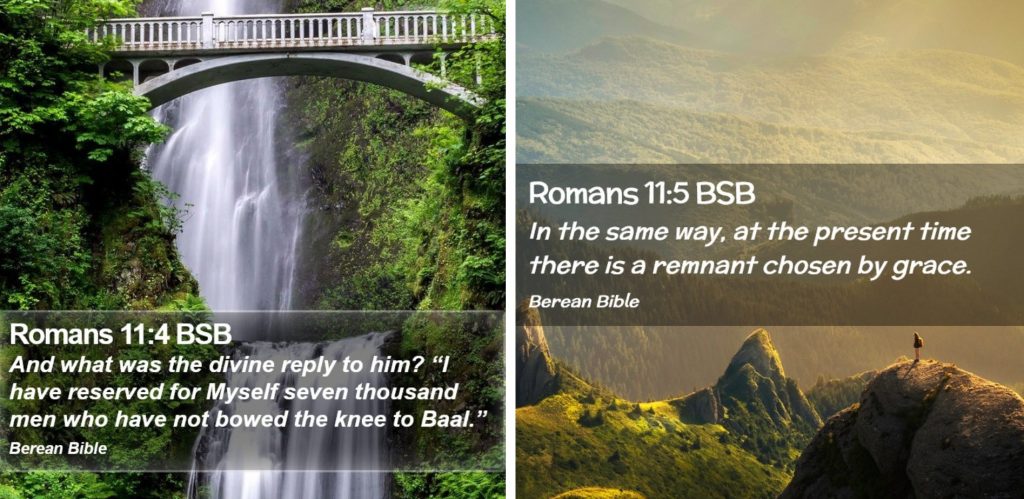
Somehow the idea of a “remnant” almost feels second rate. “We only have a few remnants left,” might mean the store is out of its best goods. Yet, for Paul, it was an exciting idea that played across the stage of all Scripture: the faithful few through whom God continues to work. For Paul, it wasn’t about being “leftovers,” but being at the center of God’s plans. That is why we want to understand the remnant in Romans 11. Paul says “there is a remnant, chosen by grace” (v. 5), and we want to be part of that remnant.

Romans 11 is a climactic moment in Paul’s writing to the church in Rome. This is a church experiencing division and strife along racial lines. Paul deals with much of this by reminding Jews and Gentiles that they are so alike. For example, they are all sinners (chs. 1-3), and all are saved by grace (ch. 4), and all have become new in Christ through baptism (ch. 6). Even so, Paul knows there are simmering and smoldering attitudes in Rome. A Jewish Christian might consider Gentiles as almost second-class Christians, thinking “Gentiles read our Bible and follow our Messiah—who is a Jew!” Gentile brothers might respond in resentment by saying, “You Jews didn’t pursue God by faith. He has rejected you and replaced you with us!” Paul answers this problem by saying that God is certainly not done with all Jews. After all, Paul says, I am a Jew (11:1)! Moreover, the inspired apostle argues, God will never be done with true Jews. There was a remnant, a small group faithful to God, even during Elijah’s time (vv. 2-4). Those 7,000 stand for all time to remind us that God always has a faithful group with whom He works to accomplish His purpose (v. 5). There are three implications for our Roman brethren, and for us, from these truths.

The Existence of the Remnant Is a Testimony to God’s Amazing Grace.

Why didn’t true belief simply vanish during the time of Elijah when God’s prophets were killed and His altars demolished? Because God sustained the faithful. In His grace and mercy, He protected them. For example, God miraculously fed Elijah at the brook Kidron by means of ravens (1 Kings 17:6). What happened with the others? We aren’t told, but God assures Elijah he is not alone! God had made incredible promises to Abraham, and those promises would not be exterminated. The key is for us to realize that neither Elijah nor the 7,000 deserved that. They could have been swept away in the furious storm of sin and idolatry that Ahab and Jezebel unleashed. Faithfulness doesn’t mean that God owes us anything. Nevertheless, by His grace, He maintains His commitment to Himself and His promises, and He chose to do that through a small group of faithful Israelites that He preserved.

This is an excellent place for American Christians to stop congratulating themselves on the size of our buildings, the effectiveness of our YouTube videos and live streaming, and be reminded: we are here by God’s grace. The freedoms we enjoy in this country have empowered us to build strong and thriving congregations. Yet it is clear that the forces of darkness would gladly sweep us away. Why hasn’t that happened yet? With so many arrayed against God’s people—the media, the courts, the legislature, and more—how are we still here? We are but a remnant. Yet, we are here, Paul reminds us, because of God’s amazing grace.

The Remnant Is There for Any (And All) Who Choose to Be a Part of It.

Perhaps few places in Scripture give us a glimpse of the joining of human will and divine sovereignty like Romans 11. Yes, God had determined that faith would not be obliterated from the earth. Who would carry the light of His knowledge forward? Who would be in the group that God used to keep the promises to Abraham alive? The answer is simple: those who chose not to bow the knee to Baal. To be sure, God does not need faithful people to accomplish His will. He can (and has) used unbelievers. Yet, God’s preference is to work with those who want to work with Him! That does not mean such folks aren’t sinners and don’t need grace. Of course not. The 7,000 Paul references in Romans 11 were still sinners needing forgiveness. However, they were the kind of people who wanted to be on God’s side. They wanted to do right. God blesses that, and God uses that. They were true Israelites. They had a heart for God. God chose them, and they chose God.

From a societal standpoint, life became complicated and difficult for Jews (such as Paul) who believed in Christ and obeyed the gospel. They had chosen Jesus of Nazareth. That meant persecution and attacks—from their own countrymen! It was hard for the 7,000 to refuse Baal, and it was hard for those New Testament Christians in Rome to be faithful. In acknowledging this truth—that our choice to serve God can bring hardship—we are brought to a third truth about being in God’s remnant. . .

Being in the Remnant Isn’t Easy, Which Means We Need Our Brethren.

The Jewish religion had long known special status under Roman law. They may have loathed the Jews, but the Romans knew not to trifle with their religious rites. There was no idol to Caesar in their temple, and their synagogues were exempt from laws about secret societies. Jews were allowed to send the temple tax to Jerusalem each year, instead of Rome. Judaism was a legal religion.

Christianity was not. For a while, it operated under the umbrella of Judaism, but the Jews who rejected Jesus worked hard to separate themselves from Christianity (Acts 18:2). By the time Paul writes Romans, Jewish disciples are having to make hard decisions about who they are for what they stand. Maybe that’s why Paul is so concerned about the church at Rome. He knows those Jewish Christians need their Gentile brothers! Thus, he calls them to be faithful to Christ, to be part of the remnant, but he also calls them to unity and care for one another. Instead of disdaining one another, Jew and Gentile needed to help each other—something Paul develops at much greater length in Romans 14-15.

Somehow all of this feels like deja vu! Many laws and special privileges have protected Christianity in the United States of America. Yet, we see those evaporating. More and more Christians will have to decide if they want to be citizens of the Kingdom or citizens of America. To refuse to bow the knee will be costly. There will be persecution and ostracism. Of course, it will be worth it as God works through the faithful, the true Israelites, to accomplish His everlasting purposes. Yet, that doesn’t mean it will be easy, and we will need our brethren to sustain and help and comfort each other. When you are the majority, you fit into society with no troubles. When you are but a remnant, you need all the help and support you can get because you will be persecuted!

Conclusion

God has a plan. In His grace, His plan always includes those who want to be part of His work and who set themselves up against the majority of society because they believe in Him and His Word. What about you and me today? Are we ready to be part of God’s faithful remnant? Are we thankful for His grace, and are we ready to refuse to bow the knee? Then let us pull ranks tight with our brothers and sisters as we continue to be lights in this ever-darkening world for Jesus Christ!

—Via Truth Magazine, Volume 66, No. 5, May 2022

https://truthmagazine.com/kindle/2022/2022-05-may/00_TM-TOC.htm

____________

The Steps That Lead to Eternal Salvation

1) Hear the gospel — for that is how faith comes (Rom. 10:17; John 20:30-31).
   
2) Believe 
in the deity of Jesus Christ, the Son of God (John 8:24; John 3:18).

3) Repent 
of sins.  For every accountable person has sinned (Romans 3:23; Romans 3:10), which causes one to be spiritually dead (Ephesians 2:1) and separated from God (Isaiah 59:1-2; Romans 6:23). Therefore, repentance of sin is necessary (Luke 13:5; Acts 17:30).  For whether the sin seems great or small, there will still be the same penalty for either (Matt. 12:36-37; 2 Cor. 5:10) — and even for a lie (Rev. 21:8).

4) Confess faith 
in Christ (Rom. 10:9-10; Acts 8:36-38).

5) Be baptized 
in water for the remission of sins (Mark 16:16; Acts 2:38; 22:16; 1 Pet. 3:21).  This is the final step that puts one into Christ (Gal. 3:26-27).  For from that baptism, one is then raised as a new creature (2 Cor. 5:17), having all sins forgiven and beginning a new life as a Christian (Rom. 6:3-4). For the one being baptized does so “through faith in the working of God” (Col. 2:12). In other words, believing that God will keep His word and forgive after one submits to these necessary steps. And now as a Christian, we then need to…

6) Continue in the faith
by living for the Lord; for, if not, salvation can be lost (Matt. 24:13; Heb. 10:36-39; Rev. 2:10; 2 Pet. 2:20-22).

——————–

Tebeau Street
CHURCH OF CHRIST
1402 Tebeau Street, Waycross, GA  31501

Sunday: 9 a.m. Bible Classes (except for last of the month Song Service)
and 10 a.m. Worship Service
Wednesday: 7 p.m. Bible Classes 
 
evangelist/editor: Tom Edwards (912) 281-9917
Tom@ThomasTEdwards.com

https://thomastedwards.com/go/all.htm (This is a link to the older version of the Gospel Observer website, but with bulletins going back to March 4, 1990.)

The Gospel Observer

“Go therefore and make disciples of all the nations…teaching them to observe all that I commanded you; and lo, I am with you always, even to the end of the age” (Matthew 28:19-20, NASB).
——————–

Contents:

1) Once Defiled, Now Blessed (Noah Diestelkamp)
2) Commit Your Way to the Lord and Trust Him (Psalm 37:5) (Mike Johnson)
3) Psalm 119:121-128 (Berean Standard Bible)

——————–

-1-

Once Defiled, Now Blessed

Noah Diestelkamp

In the summer of 1834, a Mr. Nimrod Murphree posted this advertisement in a Nashville, Tennessee, newspaper: “To all Nations, Languages and People, Greeting—Know ye, that I, Nimrod Murphree, of the City of Nashville, and the State of Tennessee, have discovered perpetual motion.” In a subsequent issue, another paid for an ad in reply to Mr. Murphree, quipping, “Probably Mr. Murphree has succeeded in handing himself over the Cumberland River, or a barn yard fence, by the straps of his boots.” Almost 200 years later, we still have not achieved perpetual motion, and I suspect Mr. Murphree did not manage to hoist himself over the fence.

While the phrase “pull himself up by his bootstraps” is often used to communicate a need to “figure it out” and “do something unassisted,” we know that the phrase describes a physical act which is literally impossible. No amount of pulling on our shoes will do the trick! The post-exilic Jews found themselves in a somewhat similar situation during the time of Zerubbabel. By God’s grace, they had been allowed to return to the land and had begun the work of rebuilding the temple. But by the time of Haggai, that work had stopped and the people said, “the time has not yet come to rebuild the house of the Lord” (Hag. 1:2). God sent the message to the people via Haggai that their lack of diligence and respect for the temple of the Lord was something worthy of repentance and gave them clear direction, saying, “Consider your ways. Go up to the hills and bring wood and build the house, that I may take pleasure in it and that I may be glorified” (Hag. 1:7-8). Just a few verses later, we are told with beautiful simplicity that, all together, the leaders and people “obeyed the voice of the Lord their God” (Hag. 1:12). However, what at first might sound like a nice “comeback” story wherein the Jews just needed to “put in a little elbow grease” and “pull themselves up by their bootstraps” takes a turn in Haggai chapter two.

In chapter two, God called upon the Jews who had seen Solomon’s temple before it was destroyed, prompting them to compare the two. “Is it not as nothing in your eyes?” asked God. The people’s work, though admirable and obedient, could not bring back the glory of Solomon’s temple. God pointed this out to help them understand a very important truth: the true glory of the temple was the presence of God. “Be strong,” He told the people, “Work, for I am with you… My Spirit remains in your midst” (Hag. 2:4-5). With this He promised that this temple would indeed be filled with His glory, to the extent that “the latter glory of this house shall be greater than the former” (Hag. 2:9). The Jews could take heart in the work they were doing, not because they did such phenomenal work, but because God would bless their work and fill the temple with His glory.

In the following section of chapter two, God commanded Haggai to inquire of the priests regarding laws of cleanliness and defilement. Haggai was to ask the priests whether holy meat could, by physical contact, make other food holy. The priests answered that it could not. Haggai’s second question asked whether a person who was unclean could, by physical contact, make food unclean. This time the priests answered it would, indeed, make the food unclean. The point God was making through Haggai was “So it is with this people… and so with every work of their hands. And what they offer there is unclean” (Hag. 2:14). The Jews were defiled, so their offering—and even their work on the temple—was defiled. Yet, just as God’s glorious presence could fill even an unimpressive temple, so, too, could He offer blessing to a defiled people. In Haggai 2:15-19, God observed that these defiled people had been without His blessing for some time. Yet, in response to the people’s obedience, God said, “From this day on I will bless you” (Hag. 2:19).

The Jews were a defiled people building a defiled temple in a defiled land. In such a situation, there is no “pulling themselves up by their bootstraps,” there is only defilement and despair. The only remedy to their situation was God’s presence and blessing. In the time of Haggai, God offered His presence to the Jews when they obeyed Him in reverence (Hag. 1:12-14). Under the new covenant, we experience the fulfillment of this! Through Jesus, we—who were defiled—are now blessed. We are temples of His Spirit, purposed for His glory! Did we accomplish this? Did we grab our bootstraps? Thank God the answer is “NO!” Along with the Jews and their temple, our lives are privileged to be a testament to the glory of God who blesses penitent and obedient hearts.

— Via Think on These Things, Vol. 57, No. 4, October-November-December 2026

——————–

-2-

Commit Your Way to the Lord and Trust Him

(Psalm 37:5)

Mike Johnson

Psalm 37:5 says, “Commit your way to the Lord, trust also in Him, And He shall bring it to pass.” Psalm 37 is an admonition to followers of God to retain their confidence in Him and not be discouraged when facing hardships in life. Among other exhortations, they were told to commit their way (course of life) to God and trust in him. Similarly, Proverbs 16:3 says, “Commit your works to the Lord, and your thoughts will be established.”

Consider the meaning of the Hebrew word translated “commit.” The root meaning involves the idea of “roll” and refers to the “rolling of a stone.” Consider the following definition: “It can also describe abstract concepts, such as reproach being rolled off (removed) from someone (Ps 119:22) or one’s ways and works rolled onto (committed, entrusted) to someone (especially God)…” (The Complete Word Study Dictionary: Old Testament). Thus, it might be said we are to roll off the burdens of life onto the Lord. Consider 1 Peter 5:6-7: “Therefore humble yourselves under the mighty hand of God, that He may exalt you in due time, casting all your care upon Him, for He cares for you.”

We must commit our lives to the Lord and trust Him to take care of us.  Further, as we handle the burdens of life, we give God credit. Have you committed your life to the Lord? Do you trust in Him? If not, you should.

— Via Seeking Things Above, Volume 1, Number 1, April 2020

——————–

-3-

Psalm 119:121-128

Ayin

121I have done what is just and right; do not leave me to my oppressors.

122Ensure Your servant’s well-being; do not let the arrogant oppress me.

123My eyes fail, looking for Your salvation, and for Your righteous promise.

124Deal with Your servant according to Your loving devotion, and teach me Your statutes.

125I am Your servant; give me understanding, that I may know Your testimonies.

126It is time for the LORD to act, for they have broken Your law.

127Therefore I love Your commandments more than gold, even the purest gold.

128Therefore I admire all Your precepts and hate every false way.

— Berean Standard Bible

______________

The Steps That Lead to Eternal Salvation

1) Hear the gospel — for that is how faith comes (Rom. 10:17; John 20:30-31).
   
2) Believe 
in the deity of Jesus Christ, the Son of God (John 8:24; John 3:18).

3) Repent 
of sins.  For every accountable person has sinned (Romans 3:23; Romans 3:10), which causes one to be spiritually dead (Ephesians 2:1) and separated from God (Isaiah 59:1-2; Romans 6:23). Therefore, repentance of sin is necessary (Luke 13:5; Acts 17:30).  For whether the sin seems great or small, there will still be the same penalty for either (Matt. 12:36-37; 2 Cor. 5:10) — and even for a lie (Rev. 21:8).

4) Confess faith 
in Christ (Rom. 10:9-10; Acts 8:36-38).

5) Be baptized
 in water for the remission of sins (Mark 16:16; Acts 2:38; 22:16; 1 Pet. 3:21).  This is the final step that puts one into Christ (Gal. 3:26-27).  For from that baptism, one is then raised as a new creature (2 Cor. 5:17), having all sins forgiven and beginning a new life as a Christian (Rom. 6:3-4). For the one being baptized does so “through faith in the working of God” (Col. 2:12). In other words, believing that God will keep His word and forgive after one submits to these necessary steps. And now as a Christian, we then need to…

6) Continue in the faith
by living for the Lord; for, if not, salvation can be lost (Matt. 24:13; Heb. 10:36-39; Rev. 2:10; 2 Pet. 2:20-22).

——————–

Tebeau Street
CHURCH OF CHRIST
1402 Tebeau Street, Waycross, GA  31501

Sunday: 9 a.m. Bible Classes (except for last of the month Song Service)
and 10 a.m. Worship Service
Wednesday: 7 p.m. Bible Classes 
 
evangelist/editor: Tom Edwards (912) 281-9917
Tom@ThomasTEdwards.com

https://thomastedwards.com/go/all.htm (This is a link to the older version of the Gospel Observer website, but with bulletins going back to March 4, 1990.)
The Gospel Observer

“Go therefore and make disciples of all the nations…teaching them to observe all that I commanded you; and lo, I am with you always, even to the end of the age” (Matthew 28:19-20, NASB).
——————–

Contents:

1) Beneath the Cross (Matt Hennecke)
2) Seek God When He May Be Found (Psalm 32:6) (Mike Johnson)
3) Psalm 119:113-120 (Berean Standard Bible)

——————–

-1-

Beneath the Cross

Matt Hennecke

Whenever we gather to partake of the Lord’s Supper, we join in remembering something we didn’t witness—Jesus’s crucifixion. We attempt to somehow “see” what we didn’t see. Is this even possible?

When Jesus instituted the Lord’s Supper, he told his followers to eat in remembrance of him; but I wasn’t at the cross and you weren’t either, so how can we remember? And we’re not the only ones who weren’t there. Except for one, that ragtag group of apostles who had followed Jesus during his three-year ministry weren’t there either.

You know who stood beneath the cross of Jesus when he was crucified? His mother. Why? One word: love. Hers was the undying devotion and amazing love of a mother. Despite the absolute horror she was about to witness, no one—neither the Jewish religious elite nor the Roman government—could have kept her from being at her son’s side when the world was at its darkest. There’s nothing in this life more powerful than a mother’s love. It is only eclipsed by God’s love who sent his son to die on the very cross beneath which Mary stood.

The Bible records several other women were present, but where were all the men? Where were the apostles? They’d run. Matthew 26:56 says simply “…all…left him and fled.” John—the one whom Jesus loved—also stood beneath the cross of Jesus. Apparently, he’d fled with the others; but love stopped his flight and, despite the danger, he returned to be with Jesus. Of the apostles, then, only one—John—saw Jesus crucified. The others had fled for their lives—the very lives Jesus was sent to save. Perhaps later, to their shame, when asked if they had seen the crucifixion of Jesus, they had to reply, “No, I wasn’t there.”  When these ambassadors of Christ who preached the gospel throughout the known world joined with fellow Christians in taking the Lord’s Supper, they likely felt pangs of guilt as they sought to remember something they had not seen.

So, again, the question: Can we remember what we’ve not witnessed? Can we “see” what we’ve not seen? Can we stand beneath the cross of Jesus and see him crucified? I think we can. I believe we are standing beneath the cross of Jesus when we assemble to partake of the Lord’s Supper.

How can I say this? Because faith is all about “seeing” what we haven’t seen. Hebrews 1:1 says, “faith is the assurance of things hoped for, the conviction of things not seen.” A bit later in the chapter—in verse 27—the writer describes faith somewhat differently. He says faith is “seeing the unseen.”

Elizabeth Clephane—a young Scottish poetess—wrote the lyrics to a hymn we occasionally sing. Sadly, she died at the young age of 39, long before her work was published. One of her poems put to music is entitled “Beneath the Cross.” Elizabeth believed we could “see the unseen” and she believed—despite not having been there—that we could stand and take a stand—even today—beneath the cross of Jesus.

Consider her beautiful lyrics:

Beneath the cross of Jesus
I fain would take my stand,
The shadow of a mighty Rock
Within a weary land.
A home within the wilderness,
A rest upon the way,
From the burning of the noontide heat,
And the burden of the day.

Upon that cross of Jesus
Mine eyes at times can see
The very dying form of One
Who suffer’d there for me.
And from my smitten heart, with tears,
Two wonders I confess:
The wonders of redeeming love,
And my unworthiness.

I take, O cross, thy shadow
For my abiding place.
I ask no other sunshine than
The sunshine of His face.
Content to let the world go by,
To know no gain nor loss,
My sinful self my only shame,
My glory all the cross.

— Via Think on These Things, July-August-September, 2026, Vol. 57, No. 3

——————–

-2-

Seek God When He May Be Found

(Psalm 32:6)

Mike Johnson

In Psalm 32, David describes what might be called the “blessedness of forgiveness.” In this Psalm, David speaks of the agony of sin and of the joy of receiving forgiveness from God. In the course of doing this (v. 6), he speaks of the need to seek God when He “may be found.” Cannot God always be found by the penitent sinner? In a sense, the answer is “yes,” but something else is involved here. God is not hiding from the sinner, but the sinner may not have the opportunity to find God. Many events in life can happen, which take away opportunities to make ourselves right with God. Consider three circumstances/events, which can occur:

1. Our conscience can become hardened or seared. Hebrews 3:13 speaks of a person being “hardened through the deceitfulness of sin”; Romans 2:5 describes an “impenitent heart”; 1 Timothy 4:2 speaks of those who have “their own conscience seared with a hot iron.” People often want to repent and confess their sins to God because their conscience bothers them. However, as time goes on, and they continue to ignore conscience, it then ceases to bother them and becomes hardened or seared. They have lost their opportunity.

2. We can die at any time (James 4:13-17). We are going to be judged based on that which we have done in our body (2 Cor. 5:10). After death, it will be too late.

3. Christ can return at any time (Mt. 24:36-44, 2 Pet. 3:10). At a time when we least expected it, time, and our opportunity to repent can end on this earth.

The point is clear. We must take advantage of the time we have now to receive forgiveness lest we lose the opportunity, i.e., we must seek forgiveness “in a time when God can be found.” II Corinthians 6:2 says, “… Behold, now is the accepted time; behold, now is the day of salvation.” All of us should seek God now while we can find Him.

— Via Seeking Things Above, Volume 1, Number 1, April 2020

——————–

-3-

Psalm 119:113-120

Samekh

113The double-minded I despise, but Your law I love.

114You are my hiding place and my shield; I put my hope in Your word.

115Depart from me, you evildoers, that I may obey the commandments of my God.

116Sustain me as You promised, that I may live; let me not be ashamed of my hope.

117Uphold me, and I will be saved, that I may always regard Your statutes.

118You reject all who stray from Your statutes, for their deceitfulness is in vain.

119All the wicked on earth You discard like dross; therefore I love Your testimonies.

120My flesh trembles in awe of You; I stand in fear of Your judgments.

— Berean Standard Bible
_____________

The Steps That Lead to Eternal Salvation

1) Hear the gospel — for that is how faith comes (Rom. 10:17; John 20:30-31).
   
2) Believe 
in the deity of Jesus Christ, the Son of God (John 8:24; John 3:18).

3) Repent 
of sins.  For every accountable person has sinned (Romans 3:23; Romans 3:10), which causes one to be spiritually dead (Ephesians 2:1) and separated from God (Isaiah 59:1-2; Romans 6:23). Therefore, repentance of sin is necessary (Luke 13:5; Acts 17:30).  For whether the sin seems great or small, there will still be the same penalty for either (Matt. 12:36-37; 2 Cor. 5:10) — and even for a lie (Rev. 21:8).

4) Confess faith 
in Christ (Rom. 10:9-10; Acts 8:36-38).

5) Be baptized
 in water for the remission of sins (Mark 16:16; Acts 2:38; 22:16; 1 Pet. 3:21).  This is the final step that puts one into Christ (Gal. 3:26-27).  For from that baptism, one is then raised as a new creature (2 Cor. 5:17), having all sins forgiven and beginning a new life as a Christian (Rom. 6:3-4). For the one being baptized does so “through faith in the working of God” (Col. 2:12). In other words, believing that God will keep His word and forgive after one submits to these necessary steps. And now as a Christian, we then need to…

6) Continue in the faith
by living for the Lord; for, if not, salvation can be lost (Matt. 24:13; Heb. 10:36-39; Rev. 2:10; 2 Pet. 2:20-22).
——————–

Tebeau Street
CHURCH OF CHRIST
1402 Tebeau Street, Waycross, GA  31501

Sunday: 9 a.m. Bible Classes (except for last of the month Song Service)
and 10 a.m. Worship Service
Wednesday: 7 p.m. Bible Classes 
 
evangelist/editor: Tom Edwards (912) 281-9917
Tom@ThomasTEdwards.com

https://thomastedwards.com/go/all.htm (This is a link to the older version of the Gospel Observer website, but with bulletins going back to March 4, 1990.)
The Gospel Observer

“Go therefore and make disciples of all the nations…teaching them to observe all that I commanded you; and lo, I am with you always, even to the end of the age” (Matthew 28:19-20, NASB).
——————–

Contents:

1) We Were Created for a Purpose (Heath Rogers)
2) Psalm 119:105-112 (Berean Standard Bible)

——————–

-1-

We Were Created for a Purpose

Heath Rogers

“When I consider Your heavens, the work of Your fingers, the moon and the stars, which You have ordained, what is man that You are mindful of him, and the son of man that You visit him?” (Ps. 8:3-4).

David saw the moon and stars as evidence of God’s creative wisdom and power. These heavenly bodies were ordained, or set in place, by God (Is. 40:26) as a permanent testimony to His power and greatness.

As David contemplated these things, he began to feel small and insignificant: “What is man that You are mindful of him?” Every generation has pondered this same question. Unlike David, many today consider their origin and purpose without knowledge of their Creator. Without God, we are mere specks in the cosmos, the products of random chance, without meaning and purpose for our existence. There is nothing to account for the intricate design clearly seen in our universe. No adequate explanation for the existence of morality, mercy, justice, and love. However, when, through His word, we know God, everything comes into sharp focus.

“And the Lord God formed man of the dust of the ground, and breathed into his nostrils the breath of life; and man became a living being” (Gen. 2:7; c.f. Ps. 100:3).

Mankind is not the latest version of a highly evolved life form, the product of eons of genetic mutations. We are not a mere collection of conscious matter without purpose propelled across the Milky Way galaxy. We are the pinnacle of God’s creation, the creature for whom He made everything else (Gen. 1:26-28). He gave us dominion over the rest of His creation. It is ours to explore, inhabit, cultivate, and use – to God’s glory.

We are fearfully and wonderfully made (Ps. 139:13-14). The cells in our bodies making up our limbs and organs are all crafted by God. He uniquely designed the features (skin color, eye color, hair color, height, etc.) that make us distinct from one another. Each individual’s aptitude and personality is, in part, the result of God’s design. God even determined the time and place that you came into this world.

Life has meaning when we realize we have a Creator to Whom we owe our existence. This is one reason we reverence, praise, and serve Him (Ps. 100).

“Then God said, ‘Let Us make man in Our image, according to Our likeness; let them have dominion over the fish of the sea, over the birds of the air, and over the cattle, over all the earth and over every creeping thing that creeps on the earth.’ So God created man in His own image; in the image of God He created him; male and female He created them” (Gen. 1:26-27).

“Created in God’s image” does not mean God has arms and legs, hands and feet, a head and torso. He does not have a physical body. It means we are the only part of His creation that has an eternal spirit. In this, we alone are like our Maker. God gave animals instinct, and some instinctive behavior is very complex. However, He gave us freewill. We can think, learn, and reason. Like our God, we have a wide range of emotions, a sense of right and wrong (morality), a desire to create, an admiration of beauty, the ability to love, and the desire to be loved in return.

After making everything else, God designed mankind to be able and willing to commune and connect with Him. God “has put eternity into man’s heart” (Eccl. 3:11, ESV). Animals received instinct, but we were given a desire to connect with something or someone greater than us. God “inhabits eternity” (Is. 57:15). This longing for eternity brings our desire for fellowship with God.

The world around us reveals our Creator’s presence (Ps. 19:1-3; Rom. 1:18-20). However, it is not enough to know God exists. God calls for us to understand and know Him. “But let him who glories glory in this, that he understands and knows Me, that I am the Lord, exercising lovingkindness, judgment, and righteousness in the earth. For in these I delight” (Jer. 9:24). Our purpose is not to obtain an education, master a skill, find a soulmate, achieve greatness, or leave a legacy. The greatest thing we can accomplish is to know and understand God.

While in Athens on his second missionary journey, Paul was roused to speak up when he saw the city completely given over to idols (Acts 17:16, 22-23). It wasn’t that the Athenians did not believe in God. They believed in a multitude of gods, but not one of them was their true Creator.

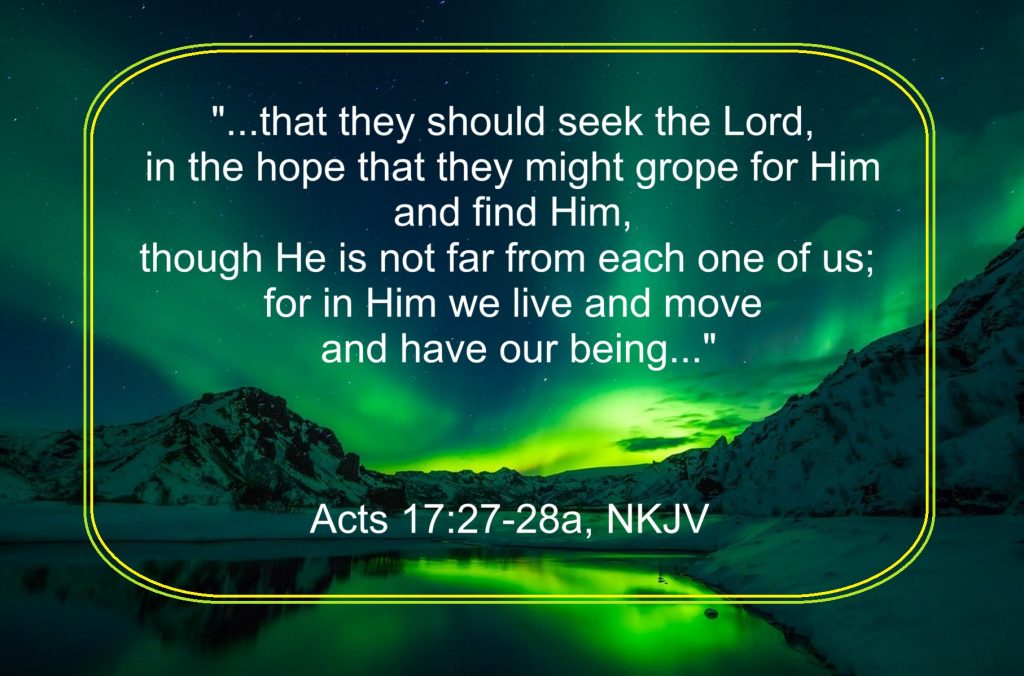
Given the opportunity to address them with the gospel, Paul told them they were made by God (Acts 17:24-26). Then he told them they had been created for a purpose: “So that they should seek the Lord, in the hope that they might grope for Him and find Him, though He is not far from each one of us; for in Him we live and move and have our being…” (vs. 27-28a).

The phrase “that they might grope for” is from a Greek word that refers to the moving of one’s hands over a surface; the effort necessary to find something in the dark. This is exactly what the people of Athens were doing by pursuing all their idols. They were acting on the eternity (knowledge of something greater than this world) that God had put in their hearts, but without the light of His revelation.

The Athenians were groping for meaning in the darkness of paganism. Today, people are searching for meaning in their lives without acknowledging God. Some have been influenced by the theory of evolution and have decided God does not exist. Others have a bad attitude toward God and prefer to live without Him. However, none of this changes the fact that they are made in His image. They are acting on the longing for eternity that He placed in their hearts, but they are looking in all the wrong places to satisfy this longing.

I picture this eternity that He placed in our hearts, or being made in God’s image, as a large, God-shaped hole within ourselves. We can search the world for something to fill this hole (satisfy this longing), but we will come up empty every time because only God can fill this void.

The message of atheistic evolution is that we are the products of chance, without meaning and purpose for our existence. The Bible’s message is that we are the most important part of God’s creation – its pinnacle and purpose.

Fish were created to swim. Birds were created to fly. When fish swim and birds fly, they fulfill their purpose and glorify their Creator. You and I have been fearfully and wonderfully made in God’s image. We were created to have fellowship with God. When we are reconciled to God through the blood of His Son (Col. 1:20-22), come to know and understand God as our Heavenly Father, and walk with Him in daily fellowship, we are finally fulfilling the purpose for which we have been uniquely created.

— via the weekly bulletin of the Knollwood church of Christ, September 2026

——————–

-2-

Psalm 119:105-112

Nun

105Your word is a lamp to my feet and a light to my path.

106I have sworn and confirmed that I will keep Your righteous judgments.

107I am severely afflicted, O LORD; revive me through Your word.

108Accept the freewill offerings of my mouth, O LORD, and teach me Your judgments.

109I constantly take my life in my hands, yet I do not forget Your law.

110The wicked have set a snare for me, but I have not strayed from Your precepts.

111Your testimonies are my heritage forever, for they are the joy of my heart.

112I have inclined my heart to perform Your statutes, even to the very end.

— Via Berea Standard Bible
 
______________

The Steps That Lead to Eternal Salvation

1) Hear the gospel — for that is how faith comes (Rom. 10:17; John 20:30-31).
   
2) Believe 
in the deity of Jesus Christ, the Son of God (John 8:24; John 3:18).

3) Repent 
of sins.  For every accountable person has sinned (Romans 3:23; Romans 3:10), which causes one to be spiritually dead (Ephesians 2:1) and separated from God (Isaiah 59:1-2; Romans 6:23). Therefore, repentance of sin is necessary (Luke 13:5; Acts 17:30).  For whether the sin seems great or small, there will still be the same penalty for either (Matt. 12:36-37; 2 Cor. 5:10) — and even for a lie (Rev. 21:8).

4) Confess faith 
in Christ (Rom. 10:9-10; Acts 8:36-38).

5) Be baptized
 in water for the remission of sins (Mark 16:16; Acts 2:38; 22:16; 1 Pet. 3:21).  This is the final step that puts one into Christ (Gal. 3:26-27).  For from that baptism, one is then raised as a new creature (2 Cor. 5:17), having all sins forgiven and beginning a new life as a Christian (Rom. 6:3-4). For the one being baptized does so “through faith in the working of God” (Col. 2:12). In other words, believing that God will keep His word and forgive after one submits to these necessary steps. And now as a Christian, we then need to…

6) Continue in the faith
by living for the Lord; for, if not, salvation can be lost (Matt. 24:13; Heb. 10:36-39; Rev. 2:10; 2 Pet. 2:20-22).
——————–

Tebeau Street
CHURCH OF CHRIST
1402 Tebeau Street, Waycross, GA  31501

Sunday: 9 a.m. Bible Classes (except for last of the month Song Service)
and 10 a.m. Worship Service
Wednesday: 7 p.m. Bible Classes 
 
evangelist/editor: Tom Edwards (912) 281-9917
Tom@ThomasTEdwards.com

https://thomastedwards.com/go/all.htm (This is a link to the older version of the Gospel Observer website, but with bulletins going back to March 4, 1990.)
© 2026

Theme by Anders Noren — Up ↑