“Go therefore and make disciples of all the nations…teaching them to observe all that I commanded you; and lo, I am with you always, even to the end of the age” (Matthew 28:19-20, NASB).
——————–
Contents:
1) How God Viewed Saul’s Worship (Kyle Pope)
2) Psalm 119:57-64 (Berean Standard Bible)
3) Ephesians 2:10 (Berean Standard Bible)
——————–
-1-
How God Viewed Saul’s Worship
Kyle Pope
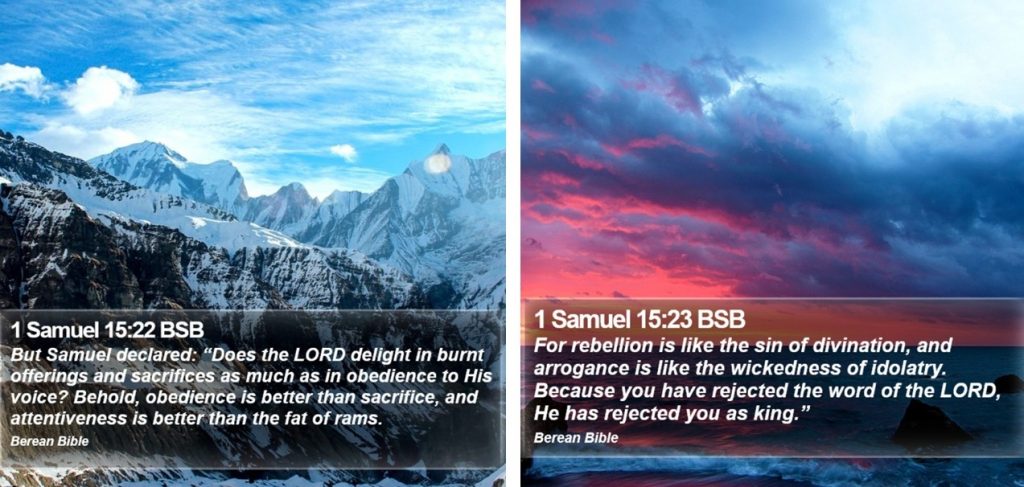
When Samuel rebuked Saul for failing to utterly destroy the Amalekites, whom God had condemned because of their sins against the Israelites in the wilderness (Deut. 25:17-19), Saul tried to defend his actions by claiming the people spared the livestock to sacrifice to God (1 Sam. 15:21). He made the common assumption that anything done with a religious motive is acceptable to God regardless of whether or not God has authorized it. In response, Samuel told him, “to obey is better than sacrifice” (1 Sam. 15:22) going on to explain, “For rebellion is as the sin of witchcraft, and stubbornness is as iniquity and idolatry” (1 Sam. 15:23a, NKJV). This explanation of the importance of obedience warrants our consideration.
The Holy Spirit led Samuel to use two words describing Saul’s actions, both of which were said to be like “witchcraft” or “iniquity and idolatry.” How shocking it must have been to Saul— just as it is often shocking to people today—to hear that something intended as an act of worship was actually like an occult, pagan, and idolatrous act!
We can learn more about this by considering the words Samuel used to describe what Saul had actually done. The first word is consistently translated “rebellion” in almost all English translations. God commanded Saul to “utterly destroy,” not only the people, but “all that they have,” even specifying, “do not spare them” (1 Sam. 15:3). By sparing the king and the best of the livestock Saul had rebelled against God’s command. The Bible in Basic English puts it that Saul had gone “against his orders.” To disobey God’s orders to do an act of worship He had not commanded was just as much a violation of God’s will as if he had practiced “witchcraft” or “divination” (NASB)—a sin he would later actually commit (1 Sam. 28:7-15).
The second word used to describe his actions has proven harder for translators to find a consistent English word that brings out its significance. Early English translations chose the word “stubbornness” (Matthew Bible – 1537; Great Bible – 1539; Bishops Bible – 1568)—a word that has continued to be used in most English translations that have followed it (KJV, ASV, RSV, YLT, NKJV, NLT, NRSV), including some Jewish translations (OJB, JPS). Saul’s actions certainly reflected an attitude of stubbornness. He wanted to do what he wanted to do! Whenever we choose our own desires over anyone or anything else in our relationships with God or others, it reflects an idolatrous way of thinking. Paul warned of those “whose god is their belly” (Phil. 3:19). While Christians should refuse to compromise truth, when it comes to following God’s word (even if it differs from what we want) or when it comes to giving in to others (for their good and to encourage peace and edification), children of God must practice what James describes as the heavenly wisdom that is “willing to yield” (James 3:19).
The word translated “stubbornness” has an unusual literal meaning. The Hebrew word patsar literally means “to press, push” (BDB). It is used only seven times in the Old Testament, and most often in its literal sense (Gen. 19:3, 9; 33:11; Judg. 19:7; 1 Sam. 15:23; 2 Kings 2:17; 5:16). In many of these examples it is used of emotional pressure one uses to urge someone to do something— much the way today we might say someone is “pushy.” What does the use of this term further indicate about Saul’s behavior?
The pushy person is one who always seems to work things out to get his or her way. It doesn’t matter who gets hurt. It doesn’t matter how our actions make others feel. It is “self-will” (Dby). It is “arrogance” (NIV). It is “pride” (BBE). Paul commanded that a Christian should “esteem others better than himself” (Phil. 2:3)—not in the sense of having poor self-esteem, but in a willingness to “look out not only for his own interests, but also for the interests of others” (Phil. 2:4). Saul was the king. He should have been a spiritual leader, urging the people to fully and completely follow the will of God. He didn’t do that. Even when he was rebuked for his sin, his pushy attitude shone through in grabbing the edge of Samuel’s robe and tearing it as Samuel turned to leave (1 Sam. 15:27). He was more concerned about being shamed before the people than the fact that he had displeased God (1 Sam. 15:30-31).
Instead of “stubbornness” a few translators have sought to convey this sense of pressing against God’s will in the choices they have made to translate patsar. Keil and Delitzsch in their Commentary on the Old Testament argue that “rebellion” and patsar are “synonymous in their meaning” (2.157). They use the word “opposition” for patsar. Hebrew Old Testament literature often utilized synonymous parallelism by which two things were stated in slightly different ways for emphasis. By failing to obey God, rather than honoring Him before the people through demonstrating the fulfillment of His word, Saul had actually acted in a manner that opposed God. In this, Saul was like Moses who struck the rock when God commanded him to speak to it. God told Moses that in doing that “you did not believe Me, to hallow Me in the eyes of the children of Israel” (Num. 20:12). We must recognize that doing what God has not authorized, regardless of our motives, dishonors and opposes God!
Along these same lines, several translations consider the sense in which Saul disregarded the authority of God in his action. He committed “insubordination” (NASB) or “insolence” (GLT). His was an act of “presumption” (ESV) and “defiance” (HCSB). Do we really recognize the supreme authority of the Lord in the choices we make regarding how we live and worship Him? He is the “only Potentate, the King of kings and Lord of lords” (1 Tim. 6:15). Jude wrote, “To God our Savior, Who alone is wise, be glory and majesty, dominion and power, both now and forever. Amen” (Jude 25). When we try to negotiate with God, and alter and dilute His commands, it is an act of “defiance” against the One who holds all authority. Saul imagined that he as king did not have to submit to the authority of God. May we never see ourselves as kings and queens over our own lives to the point that we like Saul act with such “presumption.”
— via Truth Magazine, Volume 60, No. 5, May 2016
https://www.truthmagazine.com/archives/volume60/2016_05_May_Truth_Magazine.pdf
——————–
-2-
Psalm 119:57-64
Heth
57The LORD is my portion; I have promised to keep Your words.
58I have sought Your face with all my heart; be gracious to me according to Your promise.
59I considered my ways and turned my steps to Your testimonies.
60I hurried without hesitating to keep Your commandments.
61Though the ropes of the wicked bind me, I do not forget Your law.
62At midnight I rise to give You thanks for Your righteous judgments.
63I am a friend to all who fear You, and to those who keep Your precepts.
64The earth is filled with Your loving devotion, O LORD; teach me Your statutes.
— Berean Standard Bible
——————–
Ephesians 2:10
“For we are God’s workmanship, created in Christ Jesus to do good works, which God prepared in advance as our way of life.”
— Berean Standard Bible
______________
The Steps That Lead to Eternal Salvation
1) Hear the gospel — for that is how faith comes (Rom. 10:17; John 20:30-31).
2) Believe in the deity of Jesus Christ, the Son of God (John 8:24; John 3:18).
3) Repent of sins. For every accountable person has sinned (Romans 3:23; Romans 3:10), which causes one to be spiritually dead (Ephesians 2:1) and separated from God (Isaiah 59:1-2; Romans 6:23). Therefore, repentance of sin is necessary (Luke 13:5; Acts 17:30). For whether the sin seems great or small, there will still be the same penalty for either (Matt. 12:36-37; 2 Cor. 5:10) — and even for a lie (Rev. 21:8).
4) Confess faith in Christ (Rom. 10:9-10; Acts 8:36-38).
5) Be baptized in water for the remission of sins (Mark 16:16; Acts 2:38; 22:16; 1 Pet. 3:21). This is the final step that puts one into Christ (Gal. 3:26-27). For from that baptism, one is then raised as a new creature (2 Cor. 5:17), having all sins forgiven and beginning a new life as a Christian (Rom. 6:3-4). For the one being baptized does so “through faith in the working of God” (Col. 2:12). In other words, believing that God will keep His word and forgive after one submits to these necessary steps. And now as a Christian, we then need to…
6) Continue in the faith by living for the Lord; for, if not, salvation can be lost (Matt. 24:13; Heb. 10:36-39; Rev. 2:10; 2 Pet. 2:20-22).
——————–
Tebeau Street
CHURCH OF CHRIST
1402 Tebeau Street, Waycross, GA 31501
Sunday: 9 a.m. Bible Classes (except for last of the month Song Service)
and 10 a.m. Worship Service
Wednesday: 7 p.m. Bible Classes
evangelist/editor: Tom Edwards (912) 281-9917
Tom@ThomasTEdwards.com
https://thomastedwards.com/go/all.htm (This is a link to the older version of the Gospel Observer website, but with bulletins going back to March 4, 1990.)
Recent Comments