“Go therefore and make disciples of all the nations…teaching them to observe all that I commanded you; and lo, I am with you always, even to the end of the age” (Matthew 28:19-20, NASB).
——————–
Contents:
1) Searching in All the Wrong Places (R.J. Evans)
2) Fools, Fools, and More Fools (Bryan Gibson)
3) Psalm 119:49-56 (Berean Standard Bible)
——————–

-1-
Searching in All the Wrong Places
R.J. Evans
Some years back, there was a popular song about looking for love in all the wrong places. In a similar manner, Solomon teaches us that most people in the world are searching in all the wrong places for purpose, fulfillment, true values, joy, peace and contentment. In the book of Ecclesiastes, we read of his search for life’s true meaning. He seemed to first be attracted to the pleasures of this world, laughter, and mirth. But then we hear him say, “this also was vanity” (Eccl. 2:1-2). He tried accumulating material possessions—he built houses and planted vineyards and orchards “of all kinds.” His own words were, “Whatever my eyes desired I did not keep from them” (Eccl. 2:10). He then acknowledged it all to be “vanity and grasping for the wind.” It all caused him a lot of worry, trouble, and heartache. It even distressed him to think of all the material possessions he had saved up. He became concerned about who would inherit them and what they would do with them (Eccl. 2:18-19). Throughout the book Solomon repeatedly stated— “Vanity of vanities…All is vanity.”
Jesus has set the record straight concerning where fulfillment, purpose, values, joy, peace and contentment are all to be found. He tells us to “seek first the kingdom of God and His righteousness, and all these things [necessities of life, rje] shall be added to you” (Matt. 6:33). He has also told us to “Take heed and beware of covetousness, for one’s life does not consist in the abundance of the things he possesses” (Lk. 12:15). Covetousness involves that inordinate desire for “things.” It involves that persistent striving to have more and more. But again, the words of Solomon come to mind: “He who loves silver will not be satisfied with silver; Nor he who loves abundance, with increase. This also is vanity” (Eccl. 5:10). The Apostle Paul also taught us by example when he said, “I have learned in whatever state I am, to be content” (Phil. 4:11). He tells us that joy and the peace of God are found in living for the Lord, rather than lusting after the material things of this world (Phil. 4:4-7). Thus, some of the most unhappy, unsatisfied, miserable people on this earth are those who have a “love of money” and a love for the “things” they possess (Lk. 12:15; 1 Tim. 6:6-10).
We definitely live in a materialistic, pleasure-mad society that the Bible tells us to expect in the last days (2 Tim. 3:1-5). Jesus warned in the Parable of the Sower: “Now he who received seed among the thorns is he who hears the word, and the cares of this world and the deceitfulness of riches choke the word, and he becomes unfruitful” (Matt. 13:22). It is much the same today, as it was for Solomon—the super abundance of riches can also be “vanity and grasping for the wind.”
Jeremiah told the people of his day that they should “ask for the old paths, where the good way is, And walk in it; Then you will find rest for your souls” (Jer. 6:16). I believe this same message is in order today. If we are not a Christian, we need to obey the gospel now, not later (2 Cor. 6:2). We need to get back to the “old paths” of children obeying and honoring their parents (Eph. 6:1-3); the “old paths” of building strong families and home life (Matt. 19:1-9; Eph. 5-6; Col. 3; Titus 2); the “old paths” of faithfully worshiping on the Lord’s Day (Acts 20:7; 1 Cor. 16:1-2; Heb. 10:25); the “old paths” of dressing modestly (1 Tim. 2:9); the “old paths” of living separate and apart from the world (2 Cor. 6:17-18; 1 Jn. 2:15-17); and the “old paths” of putting the kingdom and the Lord’s work first and foremost in our lives (Matt. 6:33).
Thus, there is no need for us to waste our whole life searching in all the wrong places. Solomon can save us all that time, energy, and effort. Please notice where Solomon finally and ultimately found that for which he was searching: “Let us hear the conclusion of the whole matter: Fear God and keep His commandments, For this is the whole duty of man” (Eccl. 12:13).
— via the Facebook site of the Southside church of Christ in Gonzales, Louisiana, April 3, 2016
——————–
-2-
Fools, Fools, and More Fools
Bryan Gibson
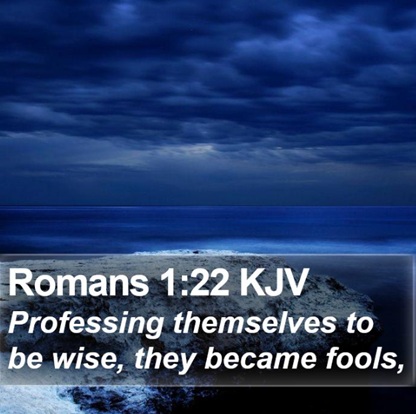
You can find them in the Bible—the rich man in the parable was one (Luke 12:20), and so were some of the Pharisees (Matthew 23:17, 19), and some of the Galatians (Galatians 3:1). Fools, we’re told, often come from those who profess to be wise (Romans 1:22). The Book of Proverbs, though, contains the most detailed description of the fool, so let’s put some of those passages together and see what we’ve got.
A fool is easy enough to spot (Proverbs 13:16)—eventually both his speech and behavior give him away (Proverbs 12:23; 15:2). Everyone can see he’s a fool, everyone that is, except himself. Let’s just say he has a pretty high opinion of himself (Proverbs 12:15; 14:3; 30:32), and perhaps that’s the reason he keeps doing the same foolish things over and over again (Proverbs 26:11).
No one can tell him anything, because he is “right in his own eyes” (Proverbs 12:15). He won’t listen to heavenly wisdom and instruction, even when it comes from those who love him most (Proverbs 1:7, 22; 10:8; 12:1; 18:2). So rather than do what the Lord tells him to do, he just does what “feels right” or what “seems right” (Proverbs 28:26; 16:25).
Someone like that—you wouldn’t expect sin to bother them, and that’s exactly the case. A fool mocks at sin (Proverbs 14:9); it’s like sport to him (Proverbs 10:23); he’s not even thinking about the consequences of his actions (Proverbs 14:16; 9:13-18).
He may not listen very well, but he sure can talk. Unfortunately, he doesn’t know when to quit (Proverbs 10:14; 12:23; 14:33; 18:2; 29:11). Others would think better of him if he could just learn to keep his mouth shut (Proverbs 17:28).
A fool is no laughing matter, because he can do a lot of harm, and not just to himself. The fact is, he’s more dangerous than “a bear robbed of her cubs” (Proverbs 17:12), and much of that has to do with the fact he gets too angry, too quickly, and stays that way too long (Proverbs 12:16; 14:16-17, 29; 27:3). He’s never met a fight he didn’t like (Proverbs 18:6-7; 20:3).
A fool has little or no regard for others, so it’s not surprising he would slander others (Proverbs 10:18), or that he would bring grief and shame to his parents (Proverbs 15:20; 17:21, 25; 19:13).
“A fool and his money are soon parted”—that’s not a direct quote from Proverbs, but the principle is certainly there. Luxury doesn’t fit him well (Proverbs 19:10), because he’ll only squander it (Proverbs 21:20).
Is there any hope for the fool? There most certainly is, if he’s willing to repent. Foolishness is a hard habit to break (Proverbs 27:22), but it can be done. “Forsake foolishness and live, and go in the way of understanding” (Proverbs 9:6). “O you simple ones, understand prudence, and you fools, be of an understanding heart” (Proverbs 8:5).
— Via the Weekly Bulletin of the Prattmont church of Christ, November 10, 2024
——————–
-3-
Psalm 119:49-56
Zayin
49Remember Your word to Your servant, upon which You have given me hope.
50This is my comfort in affliction, that Your promise has given me life.
51The arrogant utterly deride me, but I do not turn from Your law.
52I remember Your judgments of old, O LORD, and in them I find comfort.
53Rage has taken hold of me because of the wicked who reject Your law.
54Your statutes are songs to me in the house of my pilgrimage.
55In the night, O LORD, I remember Your name, that I may keep Your law.
56This is my practice, for I obey Your precepts.
— Berea Standard Bible
______________
The Steps That Lead to Eternal Salvation
1) Hear the gospel — for that is how faith comes (Rom. 10:17; John 20:30-31).
2) Believe in the deity of Jesus Christ, the Son of God (John 8:24; John 3:18).
3) Repent of sins. For every accountable person has sinned (Romans 3:23; Romans 3:10), which causes one to be spiritually dead (Ephesians 2:1) and separated from God (Isaiah 59:1-2; Romans 6:23). Therefore, repentance of sin is necessary (Luke 13:5; Acts 17:30). For whether the sin seems great or small, there will still be the same penalty for either (Matt. 12:36-37; 2 Cor. 5:10) — and even for a lie (Rev. 21:8).
4) Confess faith in Christ (Rom. 10:9-10; Acts 8:36-38).
5) Be baptized in water for the remission of sins (Mark 16:16; Acts 2:38; 22:16; 1 Pet. 3:21). This is the final step that puts one into Christ (Gal. 3:26-27). For from that baptism, one is then raised as a new creature (2 Cor. 5:17), having all sins forgiven and beginning a new life as a Christian (Rom. 6:3-4). For the one being baptized does so “through faith in the working of God” (Col. 2:12). In other words, believing that God will keep His word and forgive after one submits to these necessary steps. And now as a Christian, we then need to…
6) Continue in the faith by living for the Lord; for, if not, salvation can be lost (Matt. 24:13; Heb. 10:36-39; Rev. 2:10; 2 Pet. 2:20-22).
——————–
Tebeau Street
CHURCH OF CHRIST
1402 Tebeau Street, Waycross, GA 31501
Sunday: 9 a.m. Bible Classes (except for last of the month Song Service)
and 10 a.m. Worship Service
Wednesday: 7 p.m. Bible Classes
evangelist/editor: Tom Edwards (912) 281-9917
Tom@ThomasTEdwards.com
https://thomastedwards.com/go/all.htm (This is a link to the older version of the Gospel Observer website, but with bulletins going back to March 4, 1990.)
Recent Comments